Mindbox
Healing your mind, one thought at a time.
OVERVIEW
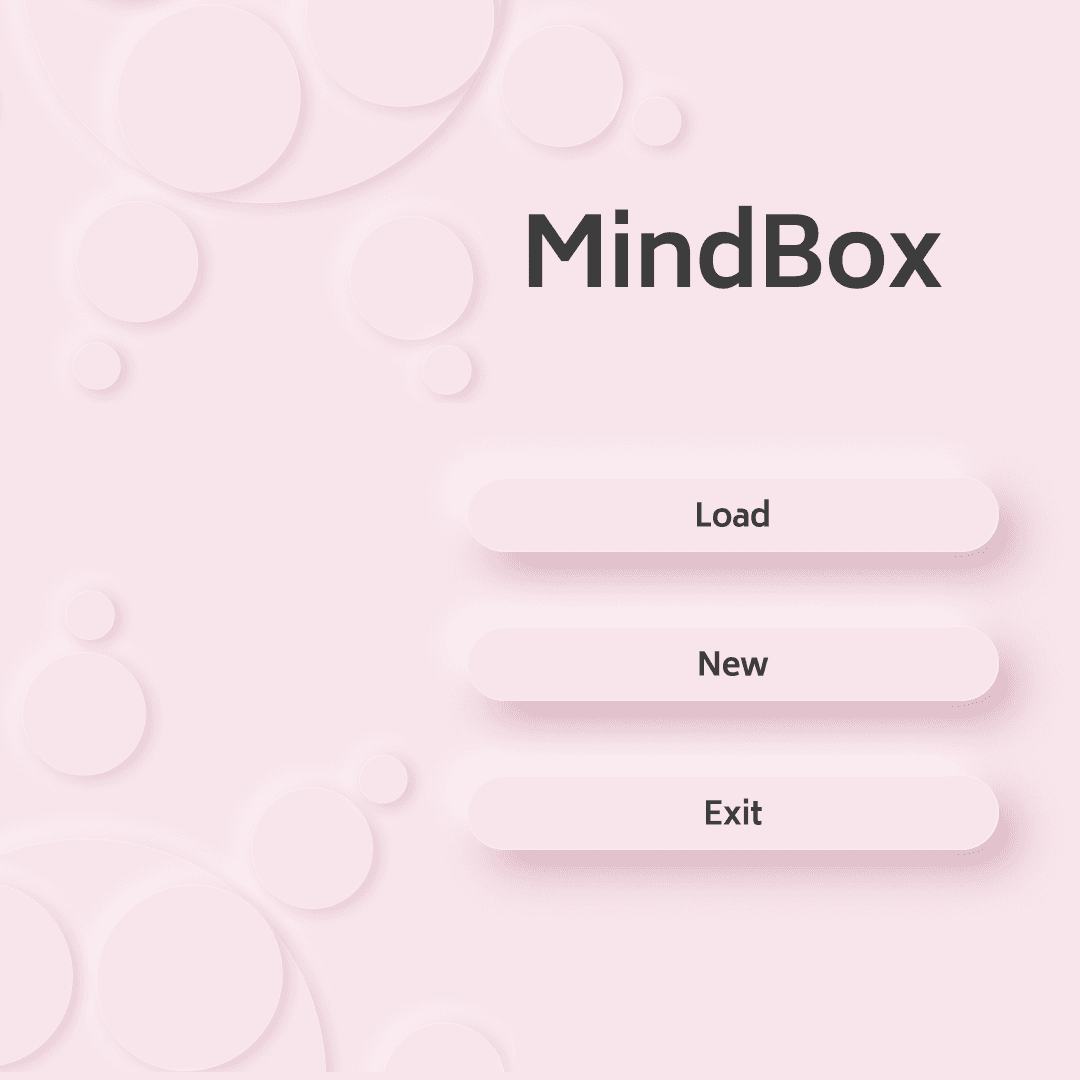
Mindbox is a sandbox-style mental health game designed to help Gen Z users confront and reprogram negative thoughts through interactive CBT mechanics. Set in an abstract mental space, players build mosaic-like brain structures, only to face emotional and cognitive disruptions that must be resolved before creativity can continue. This cycle mirrors real-world self-work and healing.
Solo Project
My Role
Lead Designer, UX Researcher
Year
2025
Tools
Figma, Procreate,
The Challenge
This is the Challenge Statement
Here is more details about the challenge for your reference. I am now talking so much more about it as you can read All the work I’ve done so Far has lead up to this explanation of the challenge. As you keep reading I will go through the process.
The Solution
This is the Solution Statement
Here is more details about the challenge for your reference. I am now talking so much more about it as you can read All the work I’ve done so Far has lead up to this explanation of the challenge. As you keep reading I will go through the process.
Feature 1
This is a description of this feature I’m Highlighting what this feature can do so you know what the app is here for.
Feature 2
This is a description of this feature I’m Highlighting what this feature can do so you know what the app is here for.
Feature 3
This is a description of this feature I’m Highlighting what this feature can do so you know what the app is here for.
The Challege
Designing a Game for Emotional Apathy
How might we design a game that makes healing feel playful—even when it’s uncomfortable?
Gen Z struggles with increasing emotional apathy and burnout, often due to mental health systems that feel cold, clinical, or inaccessible. Mindbox was created to provide a digital space where emotional healing could feel exploratory and expressive rather than diagnostic.


The Solution
Mental Health, Rewired
Create a CBT-based sandbox game that enables users to explore, build, and heal through pattern-making and digital thought reprogramming.
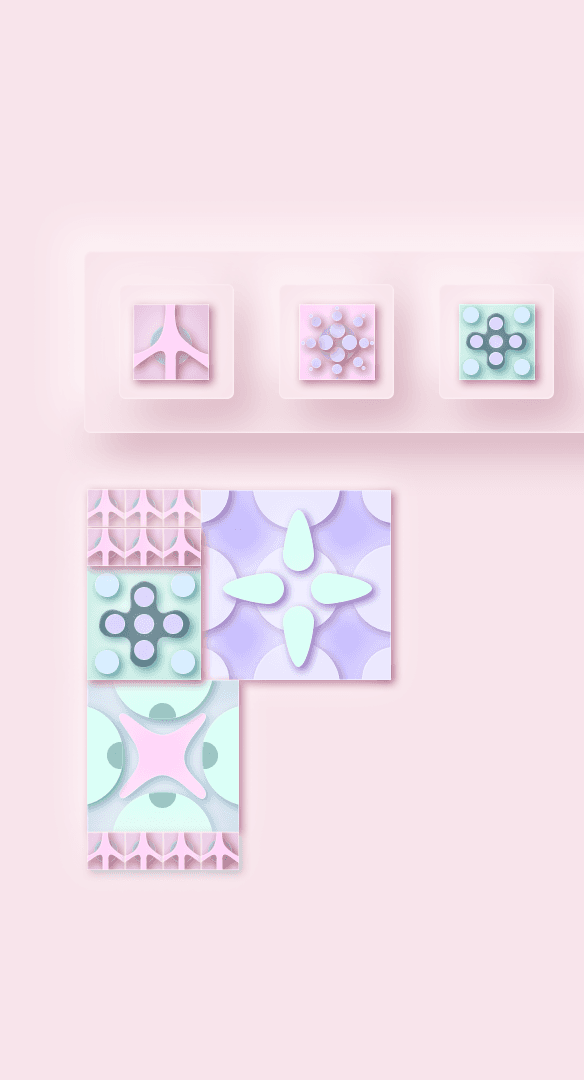
Mindbox places players inside an abstract mental landscape where they must construct a personalized “brain mosaic” using customizable tiles. Each creative session is interrupted by a mental block that mimics real-world intrusive thoughts or negative patterns. The player must complete a CBT-style prompt to continue building. This gamifies self-work while offering freedom and beauty.
Creative Healing Mechanic
Players use shapes, colours, and textures to build a personalised “mental mosaic” on a modular grid.
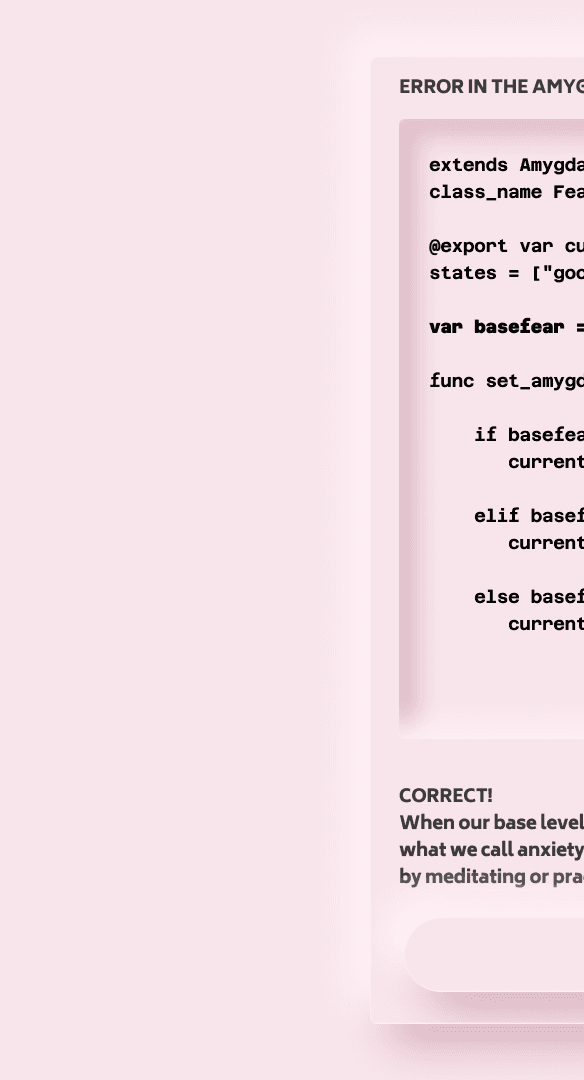
Intrusive Thought Challenges
Random CBT challenges appear mid-creation, representing mental blocks. Players must answer, reframe, or explore before continuing.
Freeform Cognitive Sandbox
No timers, no penalties—only expression, reflection, and healing.
The Challege
Designing a Game for Emotional Apathy
How might we design a game that makes healing feel playful—even when it’s uncomfortable?
Gen Z struggles with increasing emotional apathy and burnout, often due to mental health systems that feel cold, clinical, or inaccessible. Mindbox was created to provide a digital space where emotional healing could feel exploratory and expressive rather than diagnostic.
The Solution
Mental Health, Rewired
Create a CBT-based sandbox game that enables users to explore, build, and heal through pattern-making and digital thought reprogramming.
Mindbox places players inside an abstract mental landscape where they must construct a personalized “brain mosaic” using customizable tiles. Each creative session is interrupted by a mental block that mimics real-world intrusive thoughts or negative patterns. The player must complete a CBT-style prompt to continue building. This gamifies self-work while offering freedom and beauty.
Creative Healing Mechanic
Players use shapes, colours, and textures to build a personalised “mental mosaic” on a modular grid.
Intrusive Thought Challenges
Random CBT challenges appear mid-creation, representing mental blocks. Players must answer, reframe, or explore before continuing.
Freeform Cognitive Sandbox
No timers, no penalties—only expression, reflection, and healing.
The Challege
Designing a Game for Emotional Apathy
How might we design a game that makes healing feel playful—even when it’s uncomfortable?
Gen Z struggles with increasing emotional apathy and burnout, often due to mental health systems that feel cold, clinical, or inaccessible. Mindbox was created to provide a digital space where emotional healing could feel exploratory and expressive rather than diagnostic.
The Solution
Mental Health, Rewired
Create a CBT-based sandbox game that enables users to explore, build, and heal through pattern-making and digital thought reprogramming.
Mindbox places players inside an abstract mental landscape where they must construct a personalized “brain mosaic” using customizable tiles. Each creative session is interrupted by a mental block that mimics real-world intrusive thoughts or negative patterns. The player must complete a CBT-style prompt to continue building. This gamifies self-work while offering freedom and beauty.
Creative Healing Mechanic
Players use shapes, colours, and textures to build a personalised “mental mosaic” on a modular grid.
Intrusive Thought Challenges
Random CBT challenges appear mid-creation, representing mental blocks. Players must answer, reframe, or explore before continuing.
Freeform Cognitive Sandbox
No timers, no penalties—only expression, reflection, and healing.
The Challege
Designing a Game for Emotional Apathy
How might we design a game that makes healing feel playful—even when it’s uncomfortable?
Gen Z struggles with increasing emotional apathy and burnout, often due to mental health systems that feel cold, clinical, or inaccessible. Mindbox was created to provide a digital space where emotional healing could feel exploratory and expressive rather than diagnostic.
The Solution
Mental Health, Rewired
Create a CBT-based sandbox game that enables users to explore, build, and heal through pattern-making and digital thought reprogramming.
Mindbox places players inside an abstract mental landscape where they must construct a personalized “brain mosaic” using customizable tiles. Each creative session is interrupted by a mental block that mimics real-world intrusive thoughts or negative patterns. The player must complete a CBT-style prompt to continue building. This gamifies self-work while offering freedom and beauty.
Creative Healing Mechanic
Players use shapes, colours, and textures to build a personalised “mental mosaic” on a modular grid.
Intrusive Thought Challenges
Random CBT challenges appear mid-creation, representing mental blocks. Players must answer, reframe, or explore before continuing.
Freeform Cognitive Sandbox
No timers, no penalties—only expression, reflection, and healing.
The Challenge
This is the Challenge Statement
Here is more details about the challenge for your reference. I am now talking so much more about it as you can read All the work I’ve done so Far has lead up to this explanation of the challenge. As you keep reading I will go through the process.
The Solution
This is the Solution Statement
Here is more details about the challenge for your reference. I am now talking so much more about it as you can read All the work I’ve done so Far has lead up to this explanation of the challenge. As you keep reading I will go through the process.
Feature 1
This is a description of this feature I’m Highlighting what this feature can do so you know what the app is here for.
Feature 2
This is a description of this feature I’m Highlighting what this feature can do so you know what the app is here for.
Feature 3
This is a description of this feature I’m Highlighting what this feature can do so you know what the app is here for.
The Challege
Designing a Game for Emotional Apathy
How might we design a game that makes healing feel playful—even when it’s uncomfortable?
Gen Z struggles with increasing emotional apathy and burnout, often due to mental health systems that feel cold, clinical, or inaccessible. Mindbox was created to provide a digital space where emotional healing could feel exploratory and expressive rather than diagnostic.
The Solution
Mental Health, Rewired
Create a CBT-based sandbox game that enables users to explore, build, and heal through pattern-making and digital thought reprogramming.
Mindbox places players inside an abstract mental landscape where they must construct a personalized “brain mosaic” using customizable tiles. Each creative session is interrupted by a mental block that mimics real-world intrusive thoughts or negative patterns. The player must complete a CBT-style prompt to continue building. This gamifies self-work while offering freedom and beauty.
Creative Healing Mechanic
Players use shapes, colours, and textures to build a personalised “mental mosaic” on a modular grid.
Intrusive Thought Challenges
Random CBT challenges appear mid-creation, representing mental blocks. Players must answer, reframe, or explore before continuing.
Freeform Cognitive Sandbox
No timers, no penalties—only expression, reflection, and healing.
The Challenge
This is the Challenge Statement
Here is more details about the challenge for your reference. I am now talking so much more about it as you can read All the work I’ve done so Far has lead up to this explanation of the challenge. As you keep reading I will go through the process.
The Solution
This is the Solution Statement
Here is more details about the challenge for your reference. I am now talking so much more about it as you can read All the work I’ve done so Far has lead up to this explanation of the challenge. As you keep reading I will go through the process.
Feature 1
This is a description of this feature I’m Highlighting what this feature can do so you know what the app is here for.
Feature 2
This is a description of this feature I’m Highlighting what this feature can do so you know what the app is here for.
Feature 3
This is a description of this feature I’m Highlighting what this feature can do so you know what the app is here for.
The Challege
Designing a Game for Emotional Apathy
How might we design a game that makes healing feel playful—even when it’s uncomfortable?
Gen Z struggles with increasing emotional apathy and burnout, often due to mental health systems that feel cold, clinical, or inaccessible. Mindbox was created to provide a digital space where emotional healing could feel exploratory and expressive rather than diagnostic.
The Solution
Mental Health, Rewired
Create a CBT-based sandbox game that enables users to explore, build, and heal through pattern-making and digital thought reprogramming.
Mindbox places players inside an abstract mental landscape where they must construct a personalized “brain mosaic” using customizable tiles. Each creative session is interrupted by a mental block that mimics real-world intrusive thoughts or negative patterns. The player must complete a CBT-style prompt to continue building. This gamifies self-work while offering freedom and beauty.
Creative Healing Mechanic
Players use shapes, colours, and textures to build a personalised “mental mosaic” on a modular grid.
Intrusive Thought Challenges
Random CBT challenges appear mid-creation, representing mental blocks. Players must answer, reframe, or explore before continuing.
Freeform Cognitive Sandbox
No timers, no penalties—only expression, reflection, and healing.
The Challenge
This is the Challenge Statement
Here is more details about the challenge for your reference. I am now talking so much more about it as you can read All the work I’ve done so Far has lead up to this explanation of the challenge. As you keep reading I will go through the process.
The Solution
This is the Solution Statement
Here is more details about the challenge for your reference. I am now talking so much more about it as you can read All the work I’ve done so Far has lead up to this explanation of the challenge. As you keep reading I will go through the process.
Feature 1
This is a description of this feature I’m Highlighting what this feature can do so you know what the app is here for.
Feature 2
This is a description of this feature I’m Highlighting what this feature can do so you know what the app is here for.
Feature 3
This is a description of this feature I’m Highlighting what this feature can do so you know what the app is here for.
The Challege
Designing a Game for Emotional Apathy
How might we design a game that makes healing feel playful—even when it’s uncomfortable?
Gen Z struggles with increasing emotional apathy and burnout, often due to mental health systems that feel cold, clinical, or inaccessible. Mindbox was created to provide a digital space where emotional healing could feel exploratory and expressive rather than diagnostic.
The Solution
Mental Health, Rewired
Create a CBT-based sandbox game that enables users to explore, build, and heal through pattern-making and digital thought reprogramming.
Mindbox places players inside an abstract mental landscape where they must construct a personalized “brain mosaic” using customizable tiles. Each creative session is interrupted by a mental block that mimics real-world intrusive thoughts or negative patterns. The player must complete a CBT-style prompt to continue building. This gamifies self-work while offering freedom and beauty.
Creative Healing Mechanic
Players use shapes, colours, and textures to build a personalised “mental mosaic” on a modular grid.
Intrusive Thought Challenges
Random CBT challenges appear mid-creation, representing mental blocks. Players must answer, reframe, or explore before continuing.
Freeform Cognitive Sandbox
No timers, no penalties—only expression, reflection, and healing.
The Challenge
This is the Challenge Statement
Here is more details about the challenge for your reference. I am now talking so much more about it as you can read All the work I’ve done so Far has lead up to this explanation of the challenge. As you keep reading I will go through the process.
The Solution
This is the Solution Statement
Here is more details about the challenge for your reference. I am now talking so much more about it as you can read All the work I’ve done so Far has lead up to this explanation of the challenge. As you keep reading I will go through the process.
Feature 1
This is a description of this feature I’m Highlighting what this feature can do so you know what the app is here for.
Feature 2
This is a description of this feature I’m Highlighting what this feature can do so you know what the app is here for.
Feature 3
This is a description of this feature I’m Highlighting what this feature can do so you know what the app is here for.
The Challege
Designing a Game for Emotional Apathy
How might we design a game that makes healing feel playful—even when it’s uncomfortable?
Gen Z struggles with increasing emotional apathy and burnout, often due to mental health systems that feel cold, clinical, or inaccessible. Mindbox was created to provide a digital space where emotional healing could feel exploratory and expressive rather than diagnostic.
The Solution
Mental Health, Rewired
Create a CBT-based sandbox game that enables users to explore, build, and heal through pattern-making and digital thought reprogramming.
Mindbox places players inside an abstract mental landscape where they must construct a personalized “brain mosaic” using customizable tiles. Each creative session is interrupted by a mental block that mimics real-world intrusive thoughts or negative patterns. The player must complete a CBT-style prompt to continue building. This gamifies self-work while offering freedom and beauty.
Creative Healing Mechanic
Players use shapes, colours, and textures to build a personalised “mental mosaic” on a modular grid.
Intrusive Thought Challenges
Random CBT challenges appear mid-creation, representing mental blocks. Players must answer, reframe, or explore before continuing.
Freeform Cognitive Sandbox
No timers, no penalties—only expression, reflection, and healing.
The Challenge
This is the Challenge Statement
Here is more details about the challenge for your reference. I am now talking so much more about it as you can read All the work I’ve done so Far has lead up to this explanation of the challenge. As you keep reading I will go through the process.
The Solution
This is the Solution Statement
Here is more details about the challenge for your reference. I am now talking so much more about it as you can read All the work I’ve done so Far has lead up to this explanation of the challenge. As you keep reading I will go through the process.
Feature 1
This is a description of this feature I’m Highlighting what this feature can do so you know what the app is here for.
Feature 2
This is a description of this feature I’m Highlighting what this feature can do so you know what the app is here for.
Feature 3
This is a description of this feature I’m Highlighting what this feature can do so you know what the app is here for.
The Challege
Designing a Game for Emotional Apathy
How might we design a game that makes healing feel playful—even when it’s uncomfortable?
Gen Z struggles with increasing emotional apathy and burnout, often due to mental health systems that feel cold, clinical, or inaccessible. Mindbox was created to provide a digital space where emotional healing could feel exploratory and expressive rather than diagnostic.
The Solution
Mental Health, Rewired
Create a CBT-based sandbox game that enables users to explore, build, and heal through pattern-making and digital thought reprogramming.
Mindbox places players inside an abstract mental landscape where they must construct a personalized “brain mosaic” using customizable tiles. Each creative session is interrupted by a mental block that mimics real-world intrusive thoughts or negative patterns. The player must complete a CBT-style prompt to continue building. This gamifies self-work while offering freedom and beauty.
Creative Healing Mechanic
Players use shapes, colours, and textures to build a personalised “mental mosaic” on a modular grid.
Intrusive Thought Challenges
Random CBT challenges appear mid-creation, representing mental blocks. Players must answer, reframe, or explore before continuing.
Freeform Cognitive Sandbox
No timers, no penalties—only expression, reflection, and healing.
Building the Sandbox
Presenting Mindbox as a playful, reflective system
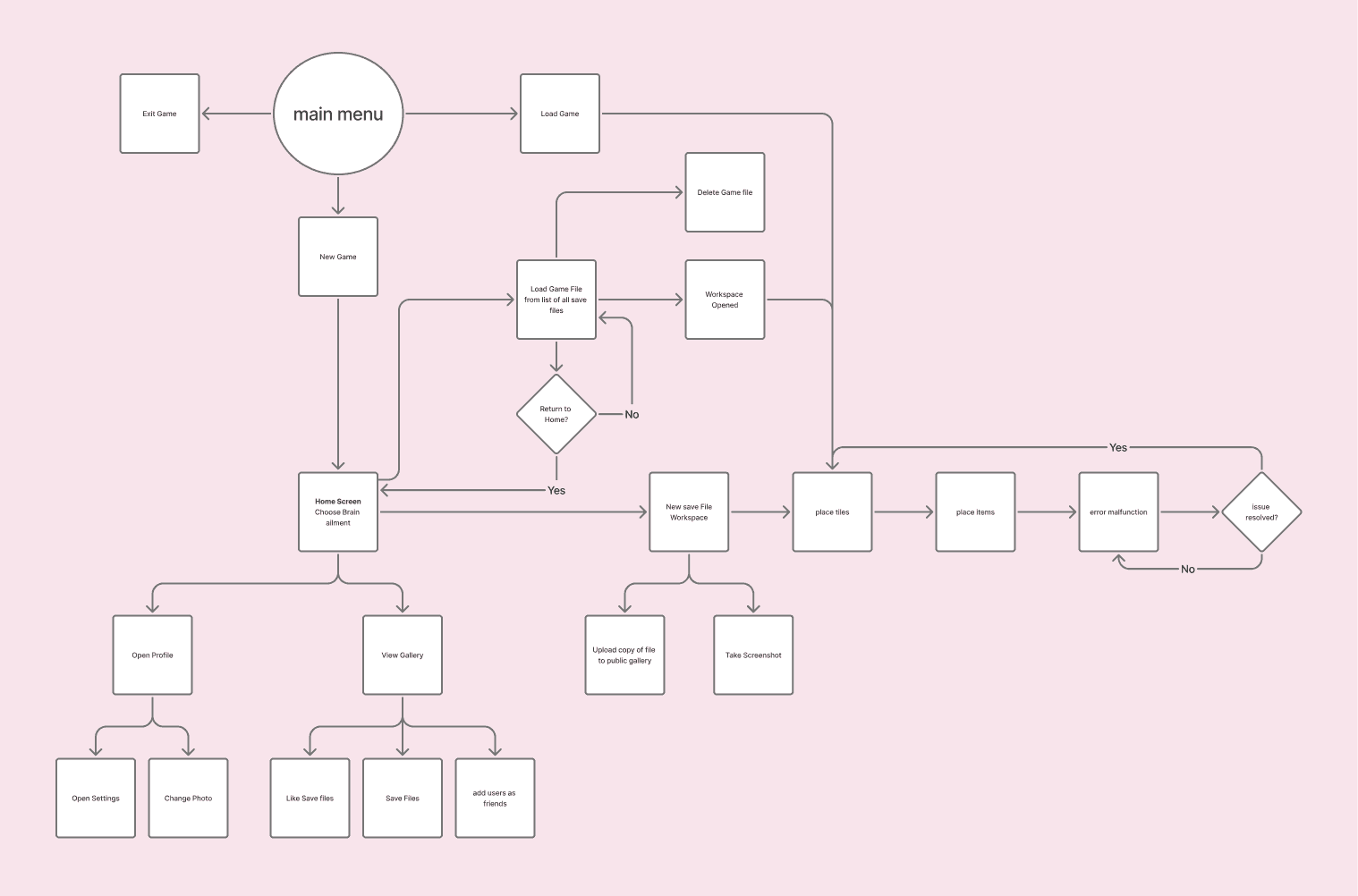
User Flow
Players explore the sandbox, are occasionally interrupted by a prompt, complete it, and return to play. The flow cycles healing and creativity seamlessly.
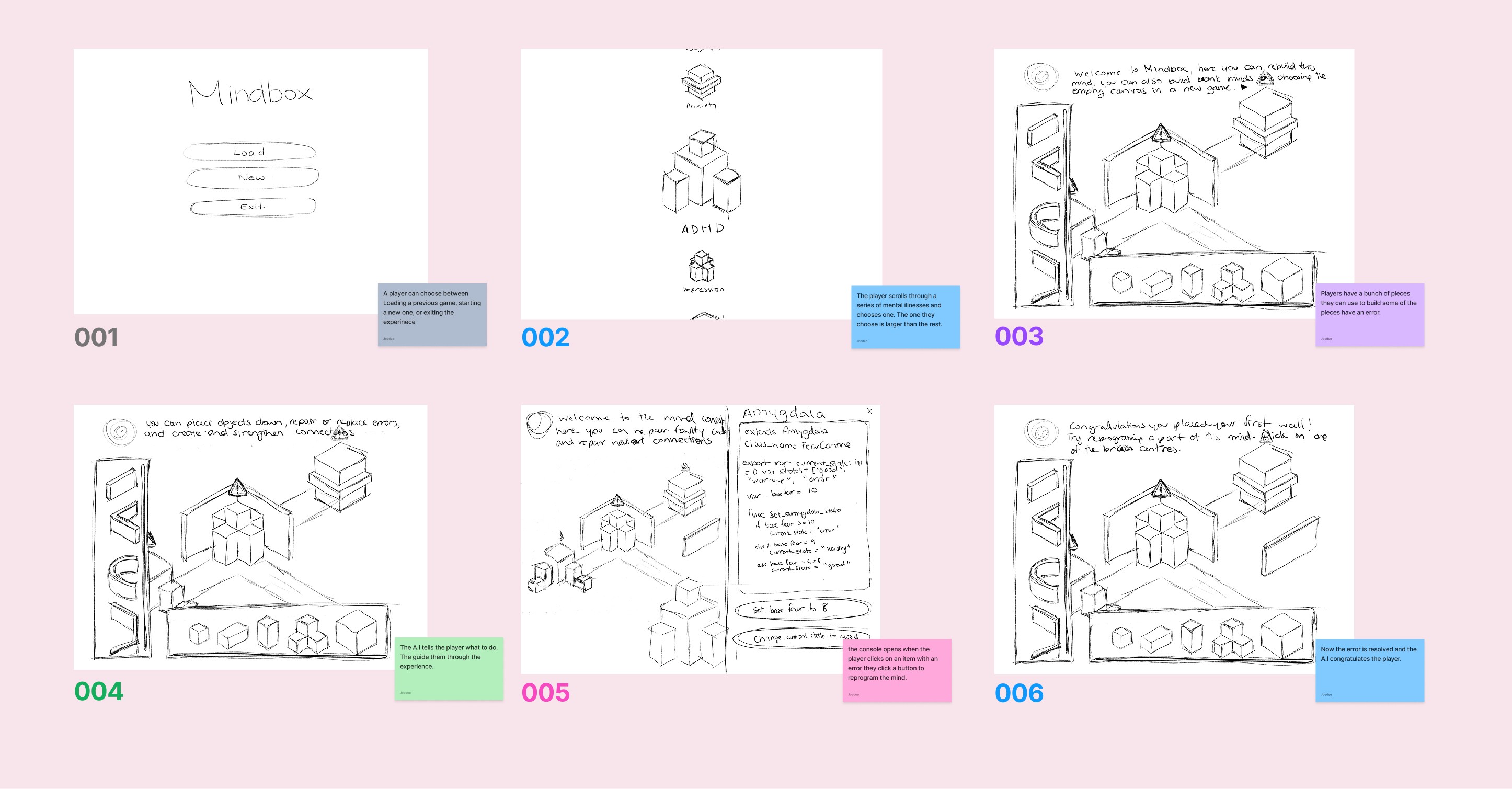
Concept Sketches
Early wireframes helped establish grid-based movement and layout spacing before integrating emotional triggers.
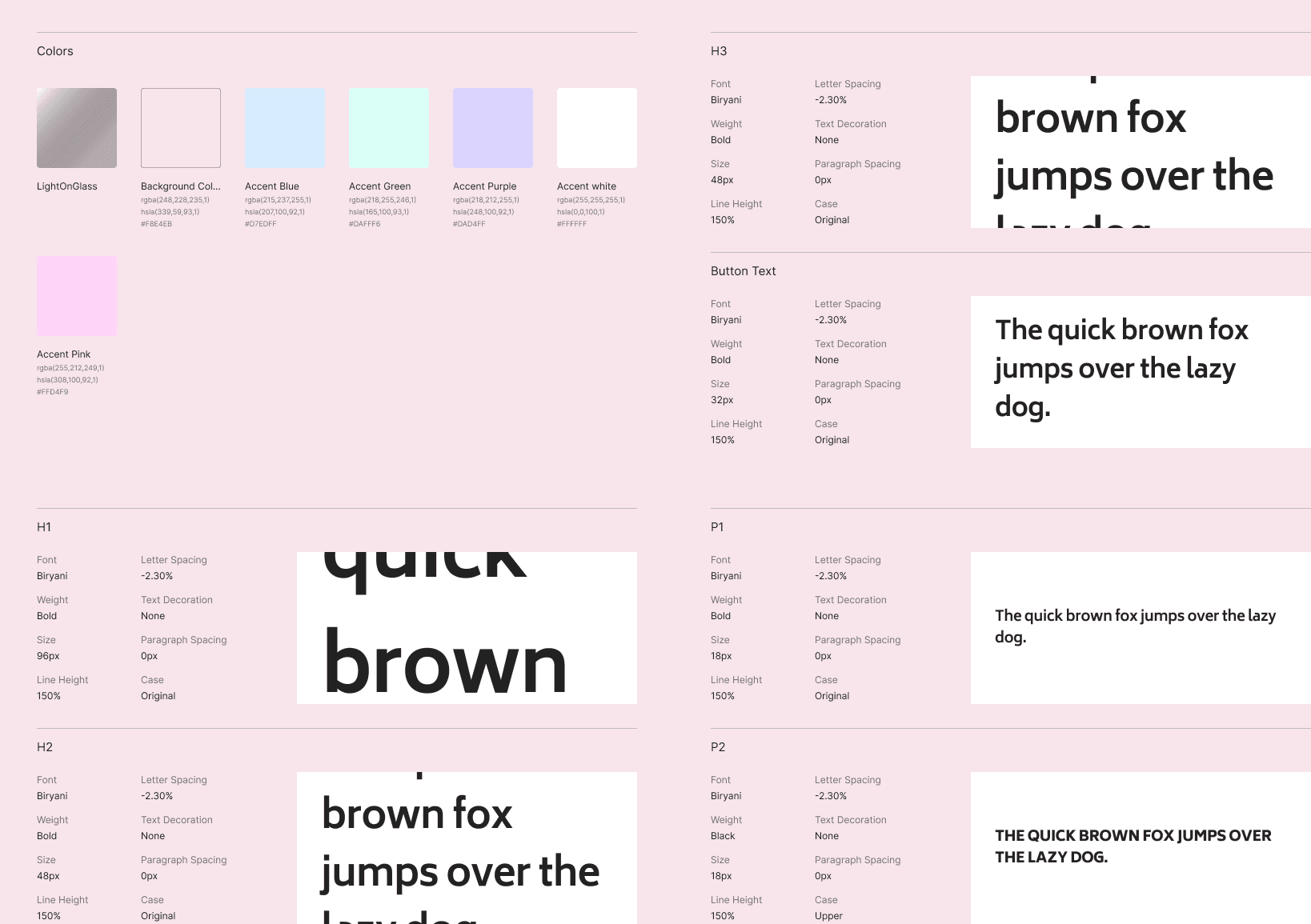
Branding
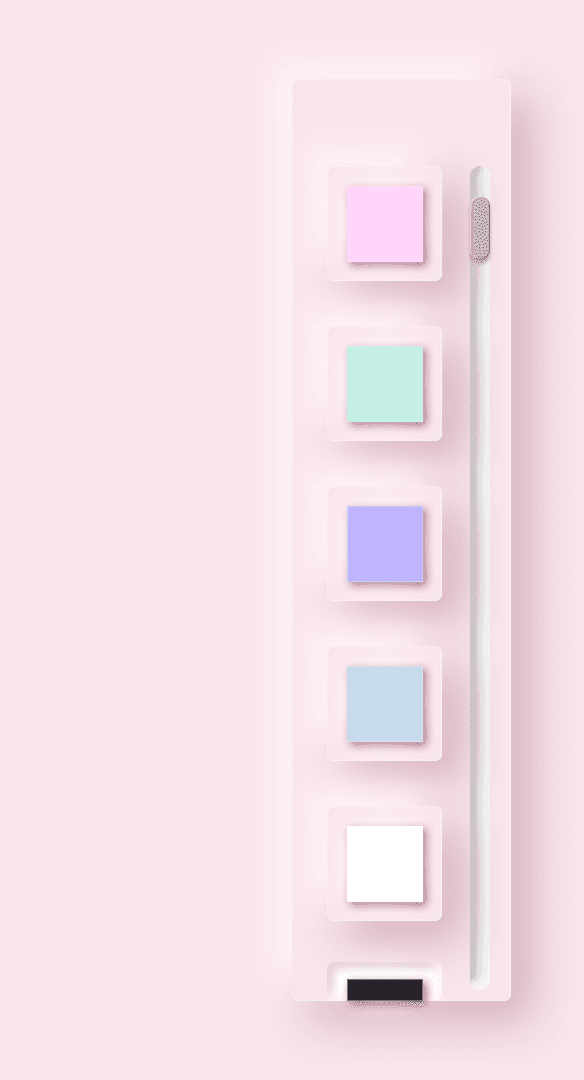
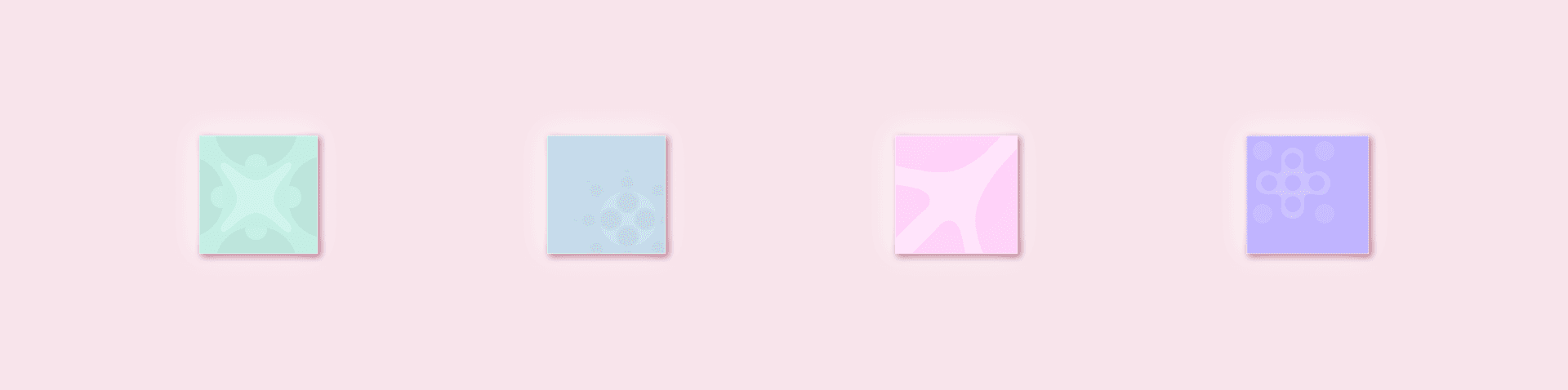
A warm neutral palette supported by muted neons was chosen to soothe while inviting creativity. Typography emphasized clarity and emotion over trendiness.
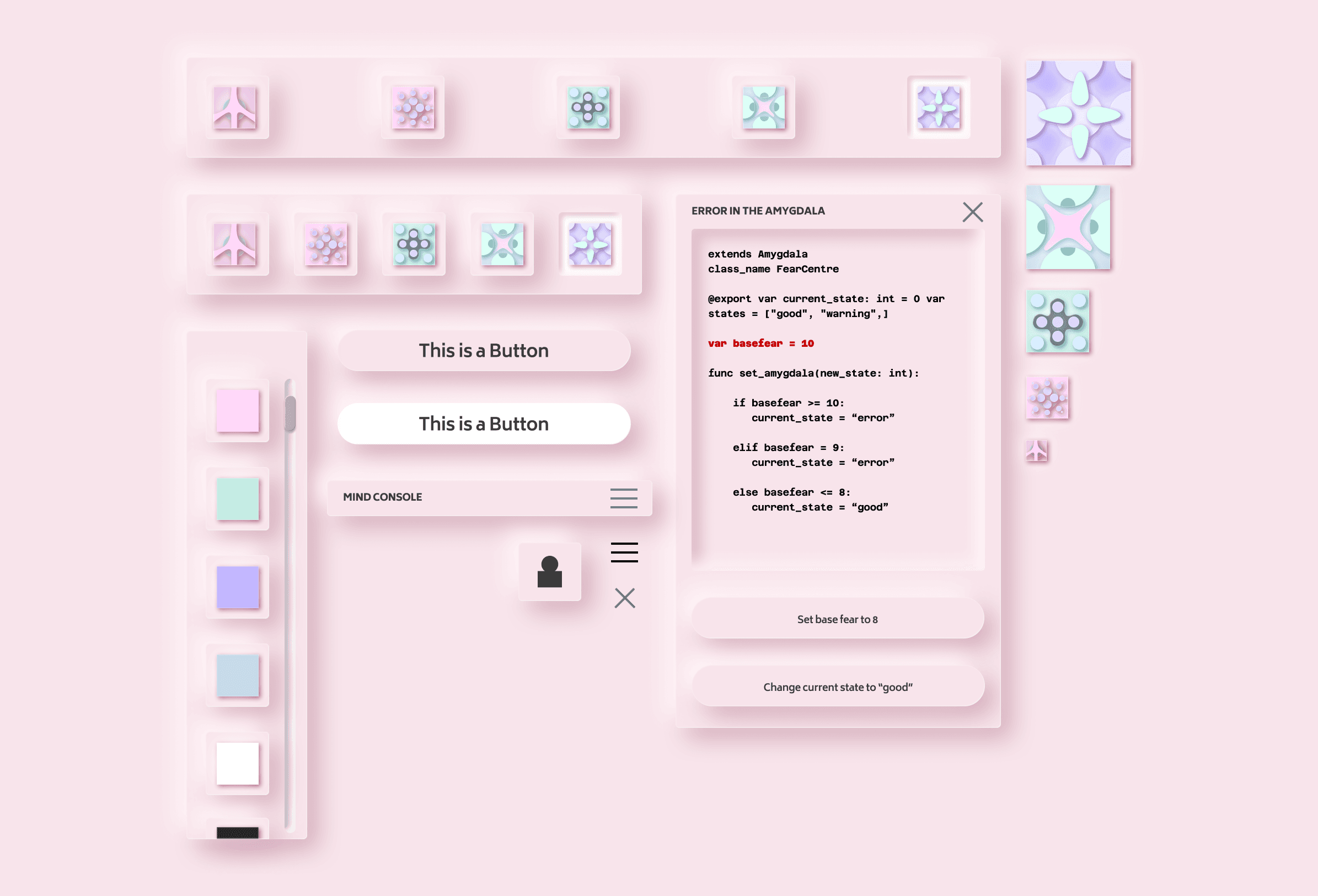
Components
Created UI elements such as emotion tiles, prompt pop-ups, grid overlays, and menu icons.
Usability Test
What Worked
Testers found the metaphor of “building your mind” visually therapeutic and calming.
Needs Work
Some requested more guidance on what to do during disruptions.
Questions
Should future versions include voice prompts or silent journaling options?
Ideas
Offer custom prompts based on emotional check-ins before each session.
Tester Feedback: Clarity of Clues
Testers shared that it wasn’t always clear what certain visual cues meant. As a result, subtle animations and highlighted states were added to make clue interactions more obvious.
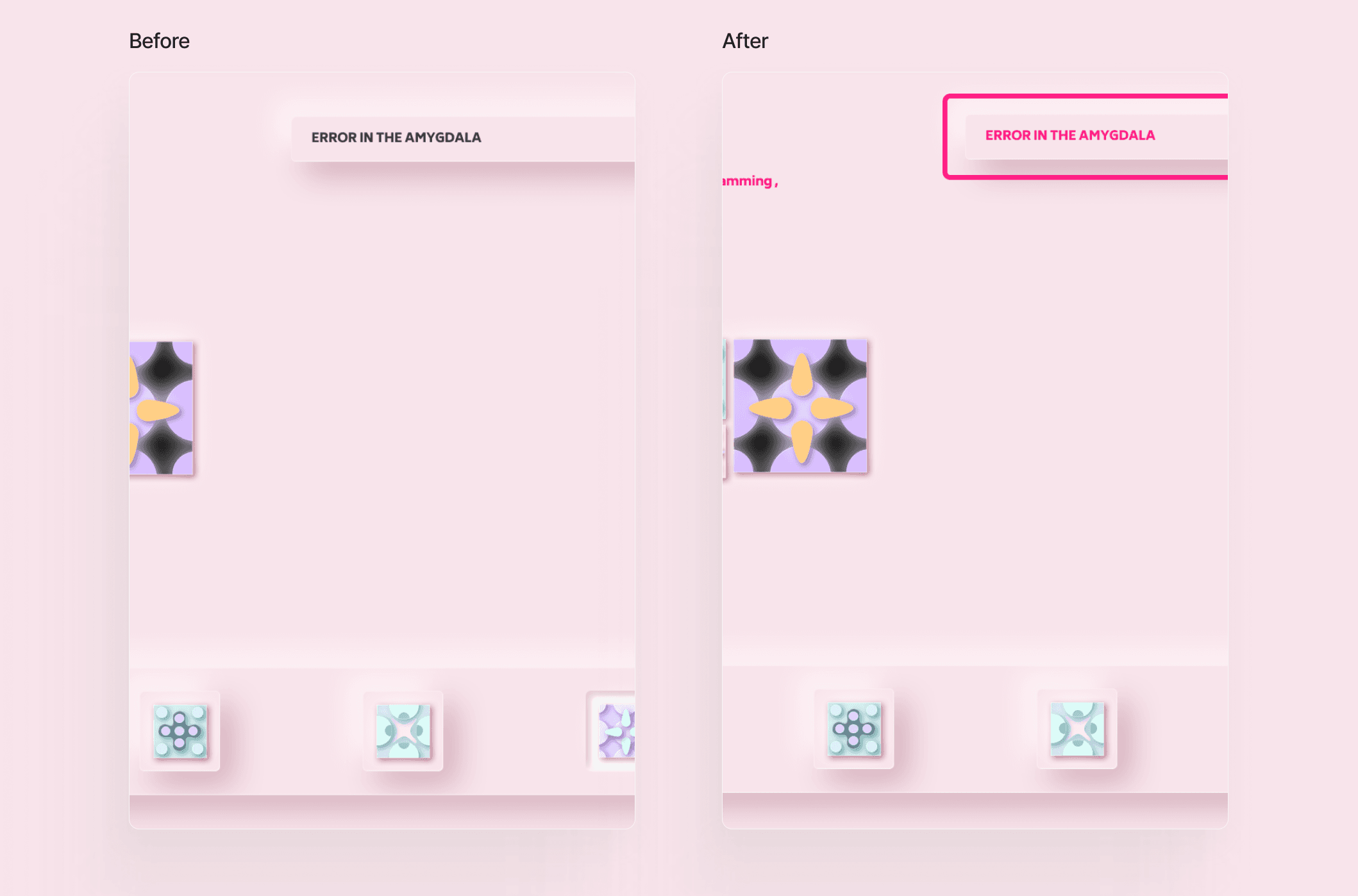
Tester Feedback: Awkward Layouts
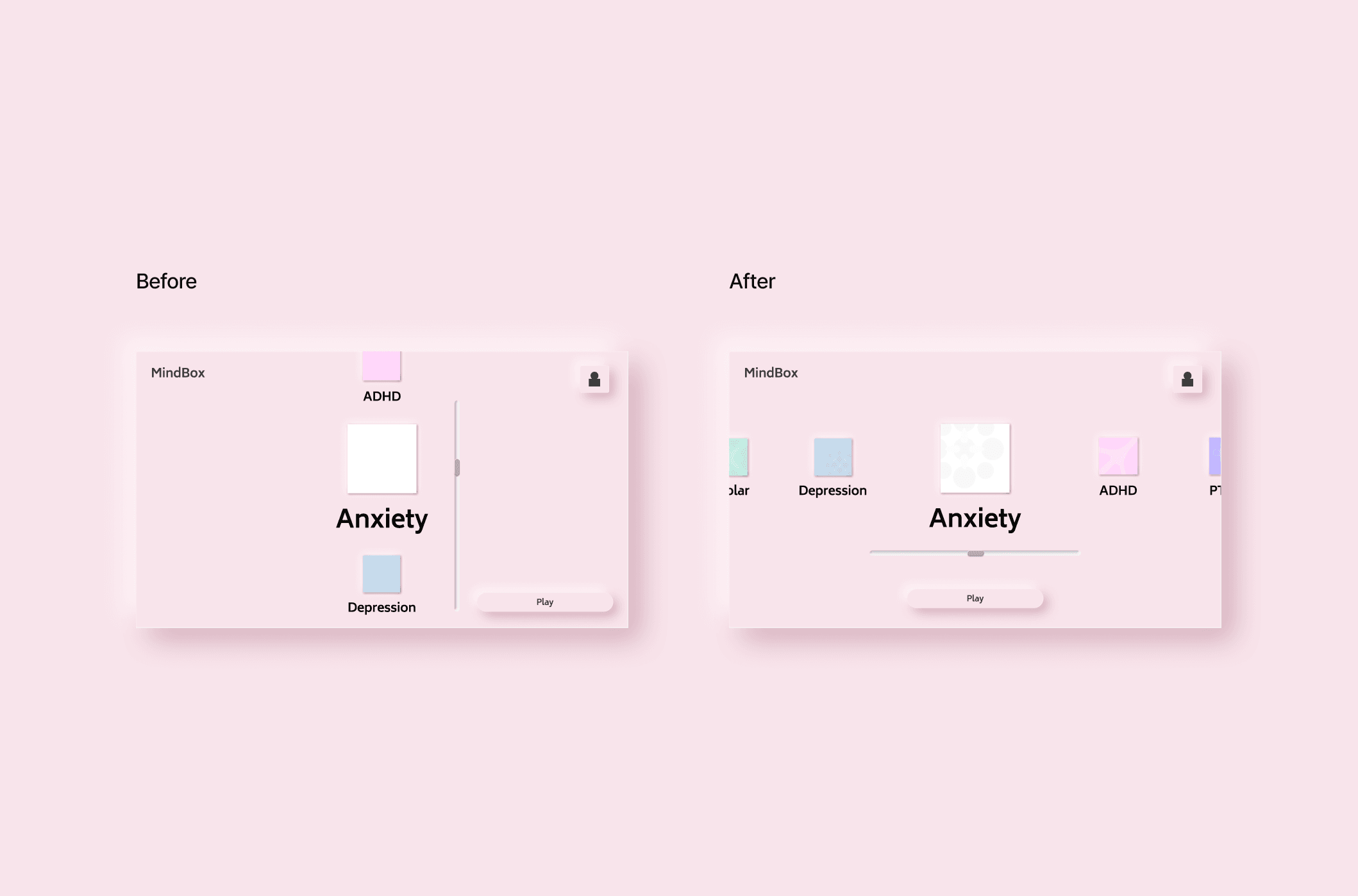
Several users didn’t understand the layout of the setup screen for chosing a workspace. The final prototype uses a classic layout to improve clarity.
Tester Feedback: Onboarding Experience
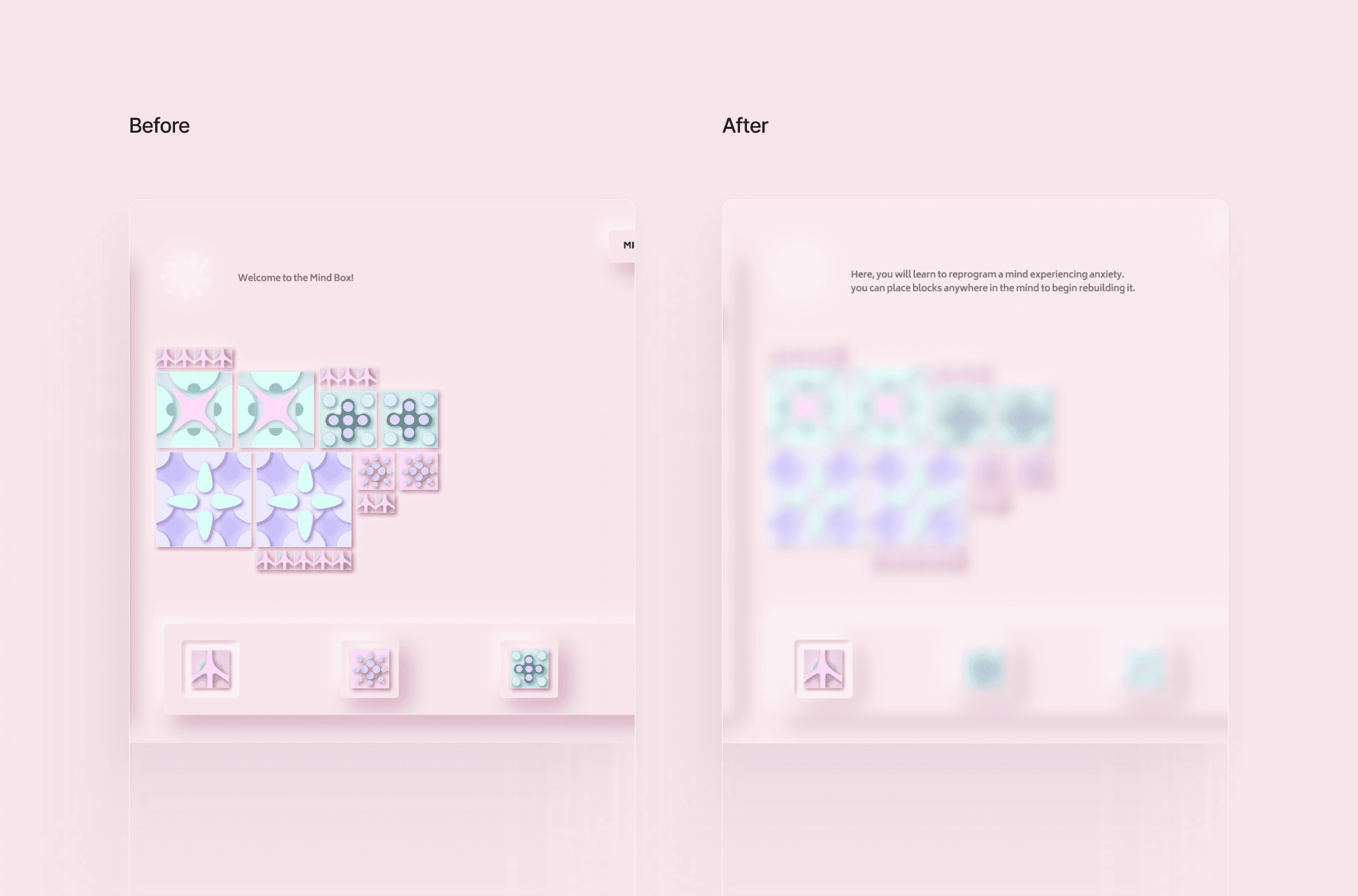
Users needed more guidance in their first session. A brief tutorial with voiceover tips was added to introduce the core mechanics and ease emotional onboarding.
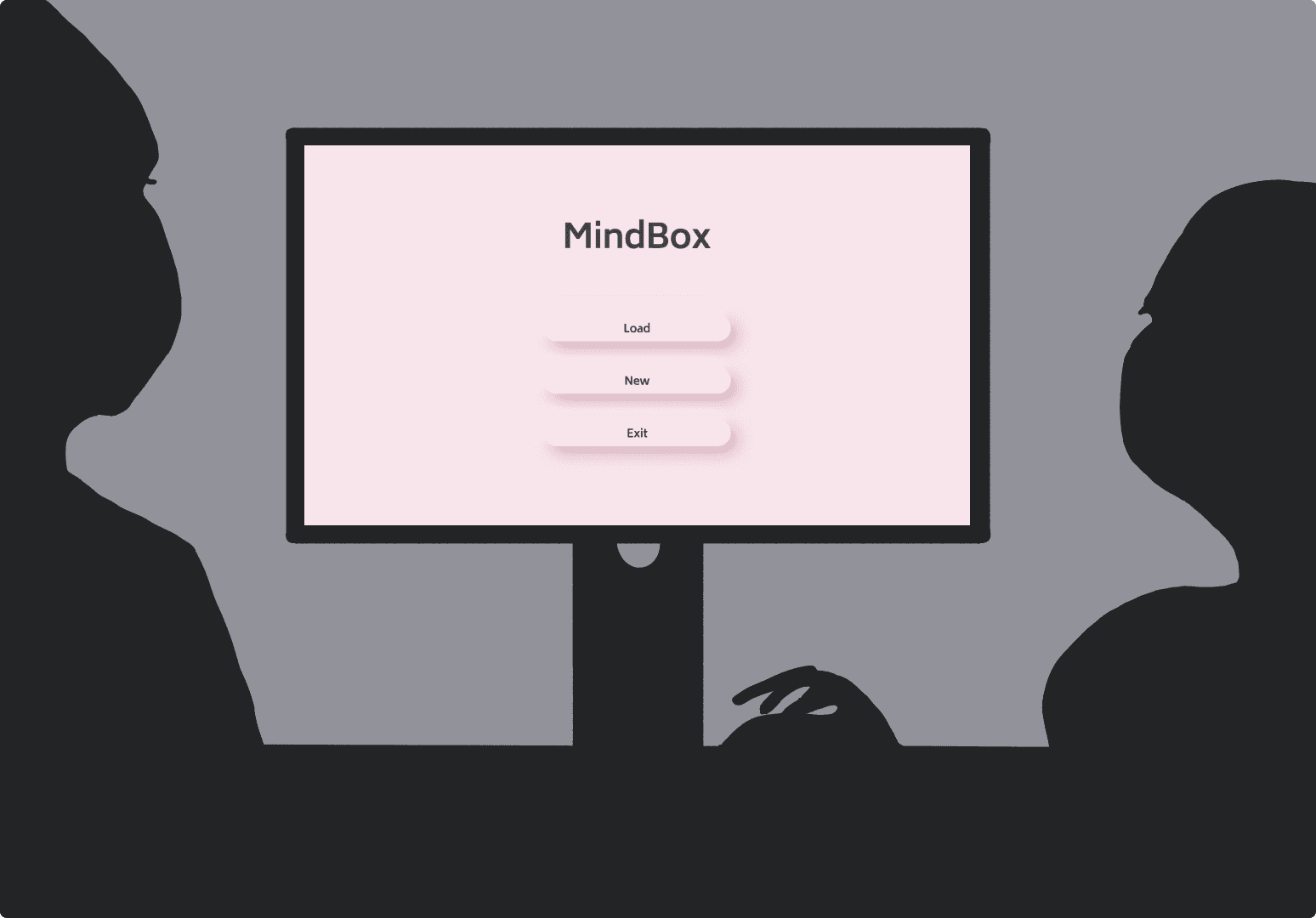
Healing Through Creation
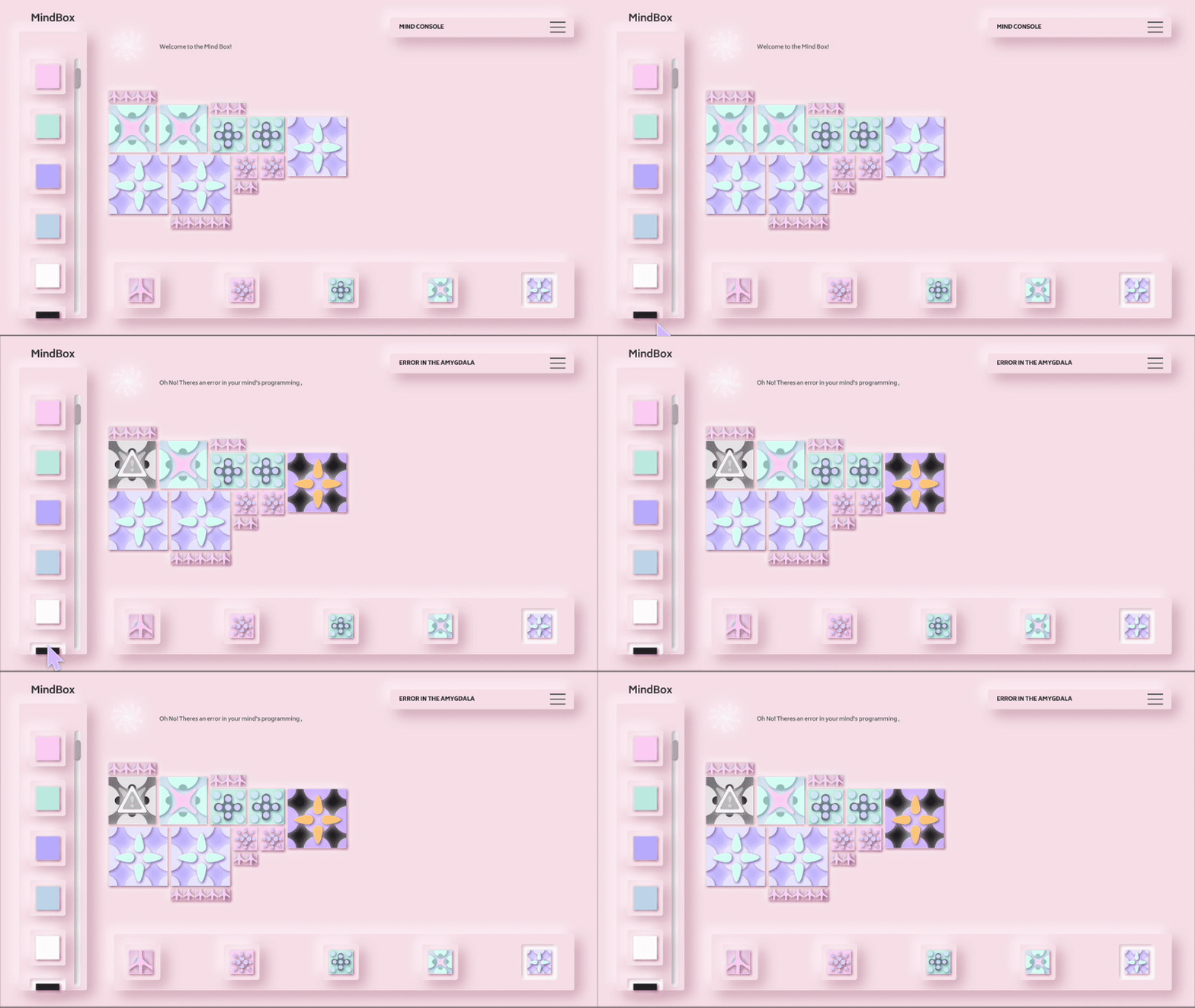
Build Your Brain
Players construct expressive mental mosaics using customizable tiles.
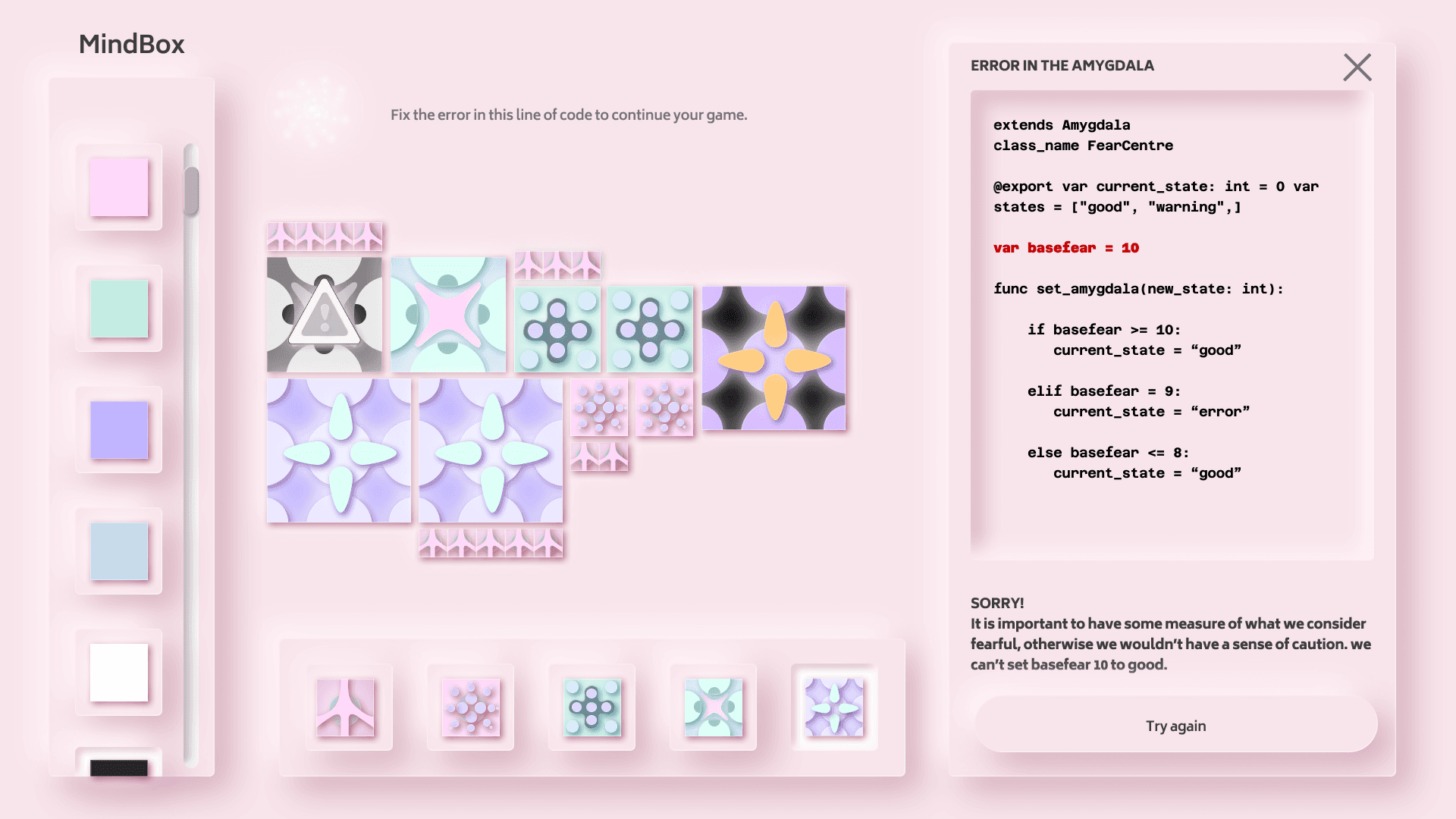
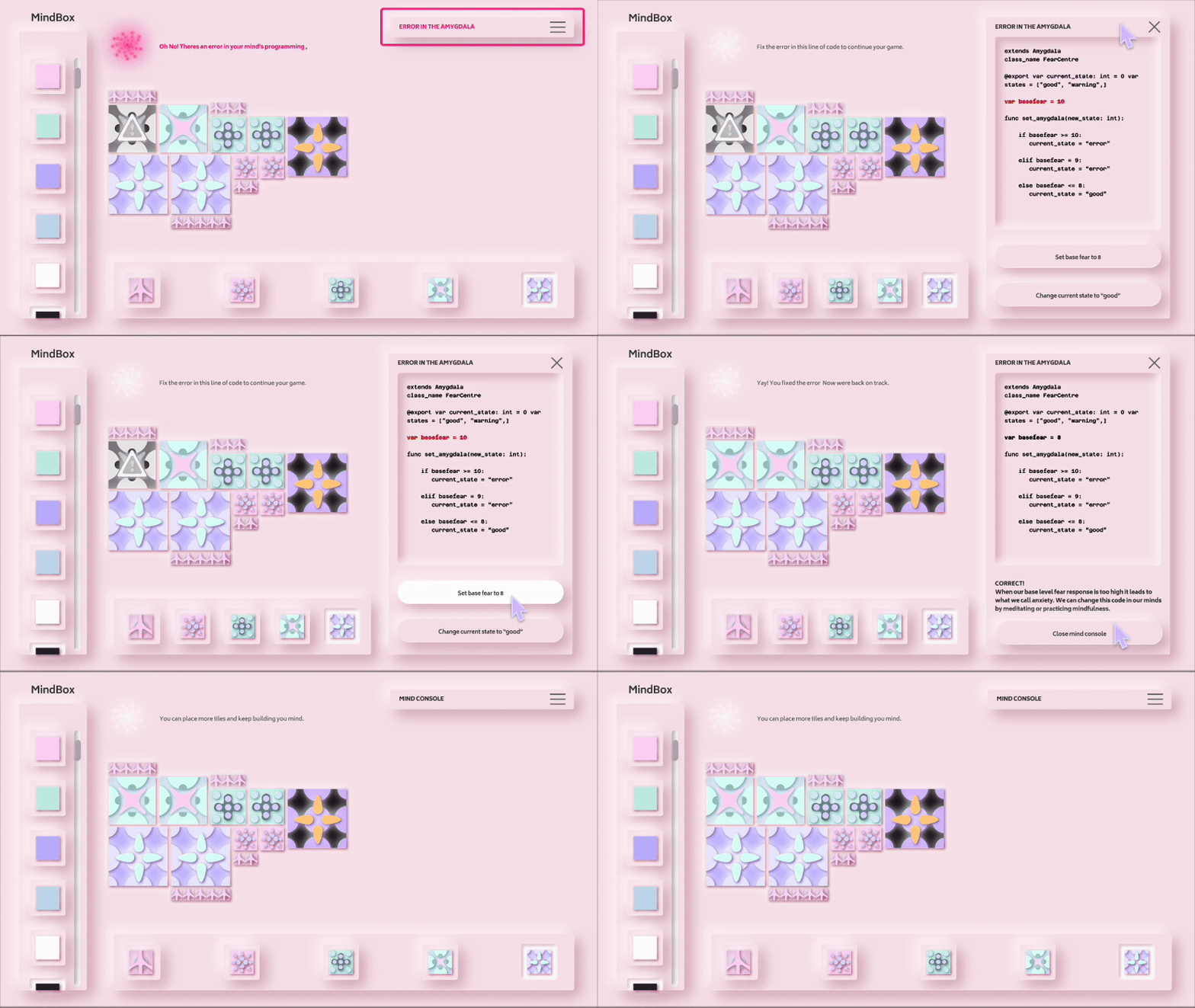
Interruptions with Insight
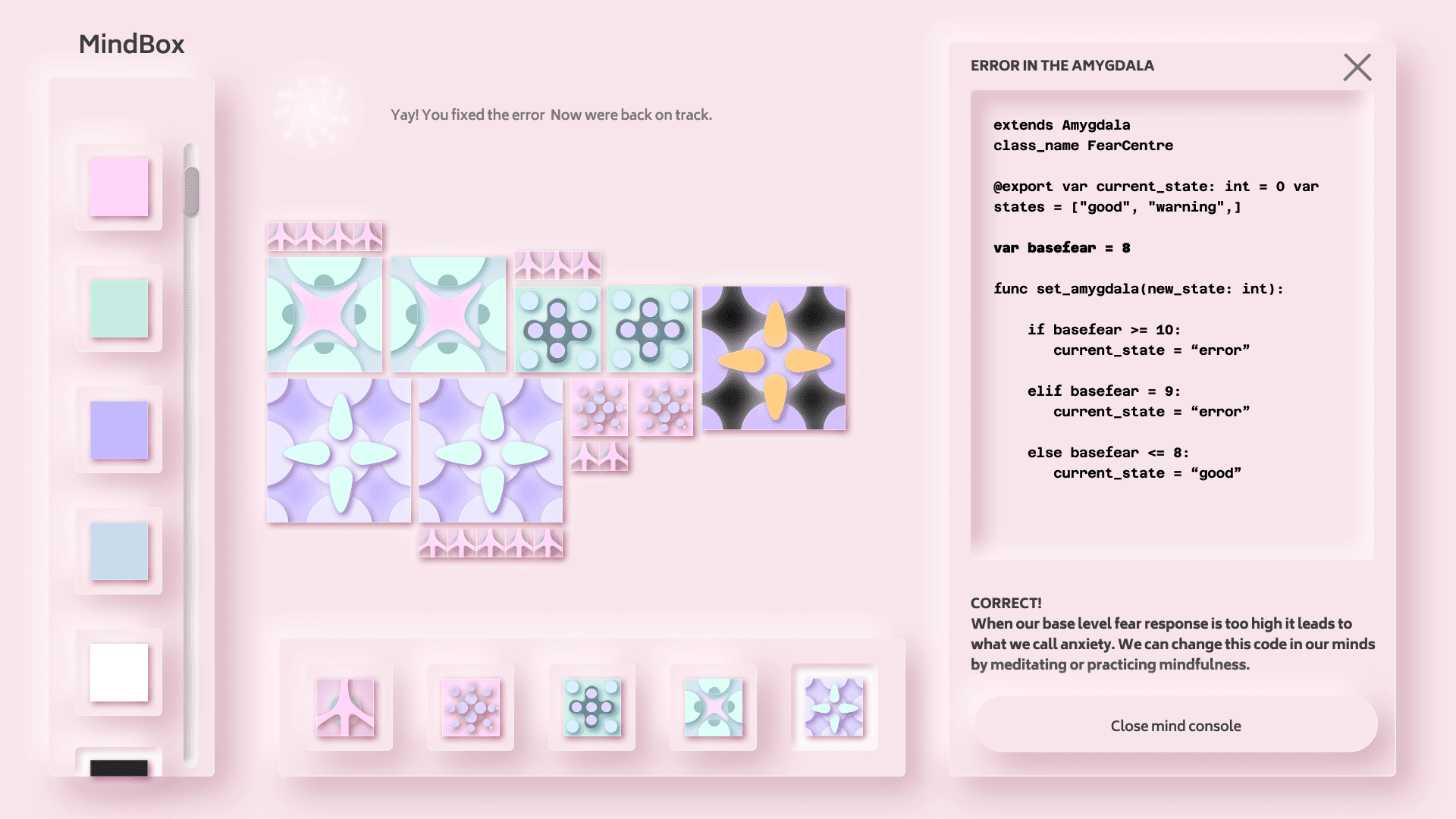
Cognitive disruptions pause gameplay, prompting healing actions.
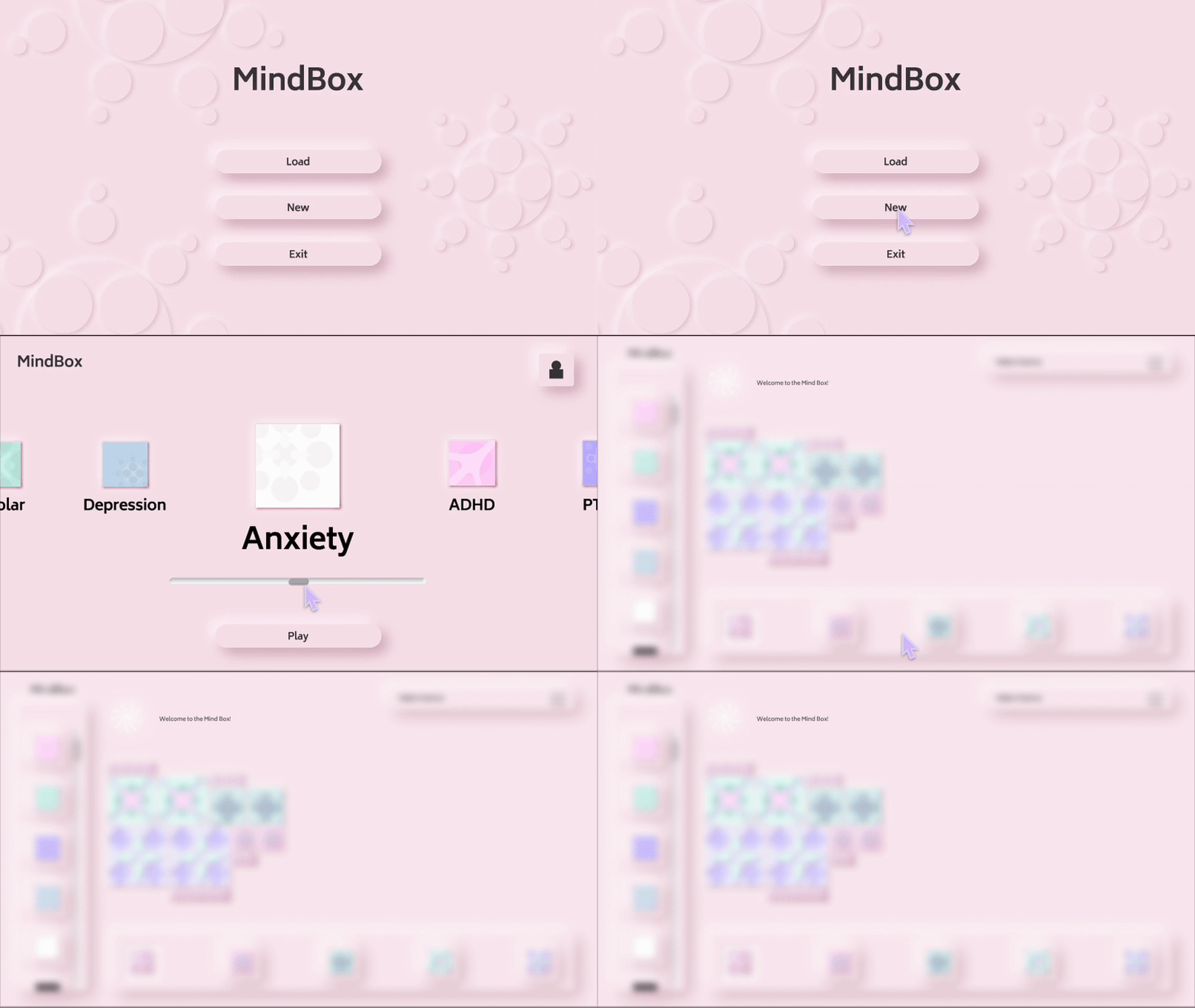
Thoughtful Flow
Seamless transitions from reflection back to creation keep the experience soothing and impactful.
Play This Prototype
Building the Sandbox
Presenting Mindbox as a playful, reflective system
User Flow
Players explore the sandbox, are occasionally interrupted by a prompt, complete it, and return to play. The flow cycles healing and creativity seamlessly.
Concept Sketches
Early wireframes helped establish grid-based movement and layout spacing before integrating emotional triggers.
Branding
A warm neutral palette supported by muted neons was chosen to soothe while inviting creativity. Typography emphasized clarity and emotion over trendiness.
Components
Created UI elements such as emotion tiles, prompt pop-ups, grid overlays, and menu icons.
Usability Test
What Worked
Testers found the metaphor of “building your mind” visually therapeutic and calming.
Needs Work
Some requested more guidance on what to do during disruptions.
Questions
Should future versions include voice prompts or silent journaling options?
Ideas
Offer custom prompts based on emotional check-ins before each session.
Tester Feedback: Clarity of Clues
Testers shared that it wasn’t always clear what certain visual cues meant. As a result, subtle animations and highlighted states were added to make clue interactions more obvious.
Tester Feedback: Awkward Layouts
Several users didn’t understand the layout of the setup screen for chosing a workspace. The final prototype uses a classic layout to improve clarity.
Tester Feedback: Onboarding Experience
Users needed more guidance in their first session. A brief tutorial with voiceover tips was added to introduce the core mechanics and ease emotional onboarding.
Healing Through Creation
Build Your Brain
Players construct expressive mental mosaics using customizable tiles.
Interruptions with Insight
Cognitive disruptions pause gameplay, prompting healing actions.
Thoughtful Flow
Seamless transitions from reflection back to creation keep the experience soothing and impactful.
Play This Prototype
Building the Sandbox
Presenting Mindbox as a playful, reflective system
User Flow
Players explore the sandbox, are occasionally interrupted by a prompt, complete it, and return to play. The flow cycles healing and creativity seamlessly.
Concept Sketches
Early wireframes helped establish grid-based movement and layout spacing before integrating emotional triggers.
Branding
A warm neutral palette supported by muted neons was chosen to soothe while inviting creativity. Typography emphasized clarity and emotion over trendiness.
Components
Created UI elements such as emotion tiles, prompt pop-ups, grid overlays, and menu icons.
Usability Test
What Worked
Testers found the metaphor of “building your mind” visually therapeutic and calming.
Needs Work
Some requested more guidance on what to do during disruptions.
Questions
Should future versions include voice prompts or silent journaling options?
Ideas
Offer custom prompts based on emotional check-ins before each session.
Tester Feedback: Clarity of Clues
Testers shared that it wasn’t always clear what certain visual cues meant. As a result, subtle animations and highlighted states were added to make clue interactions more obvious.
Tester Feedback: Awkward Layouts
Several users didn’t understand the layout of the setup screen for chosing a workspace. The final prototype uses a classic layout to improve clarity.
Tester Feedback: Onboarding Experience
Users needed more guidance in their first session. A brief tutorial with voiceover tips was added to introduce the core mechanics and ease emotional onboarding.
Healing Through Creation
Build Your Brain
Players construct expressive mental mosaics using customizable tiles.
Interruptions with Insight
Cognitive disruptions pause gameplay, prompting healing actions.
Thoughtful Flow
Seamless transitions from reflection back to creation keep the experience soothing and impactful.
Play This Prototype
Listening to Emotional Fatigue
What does healing need to feel like for Gen Z to actually engage with it?
Apathy is the Default Setting
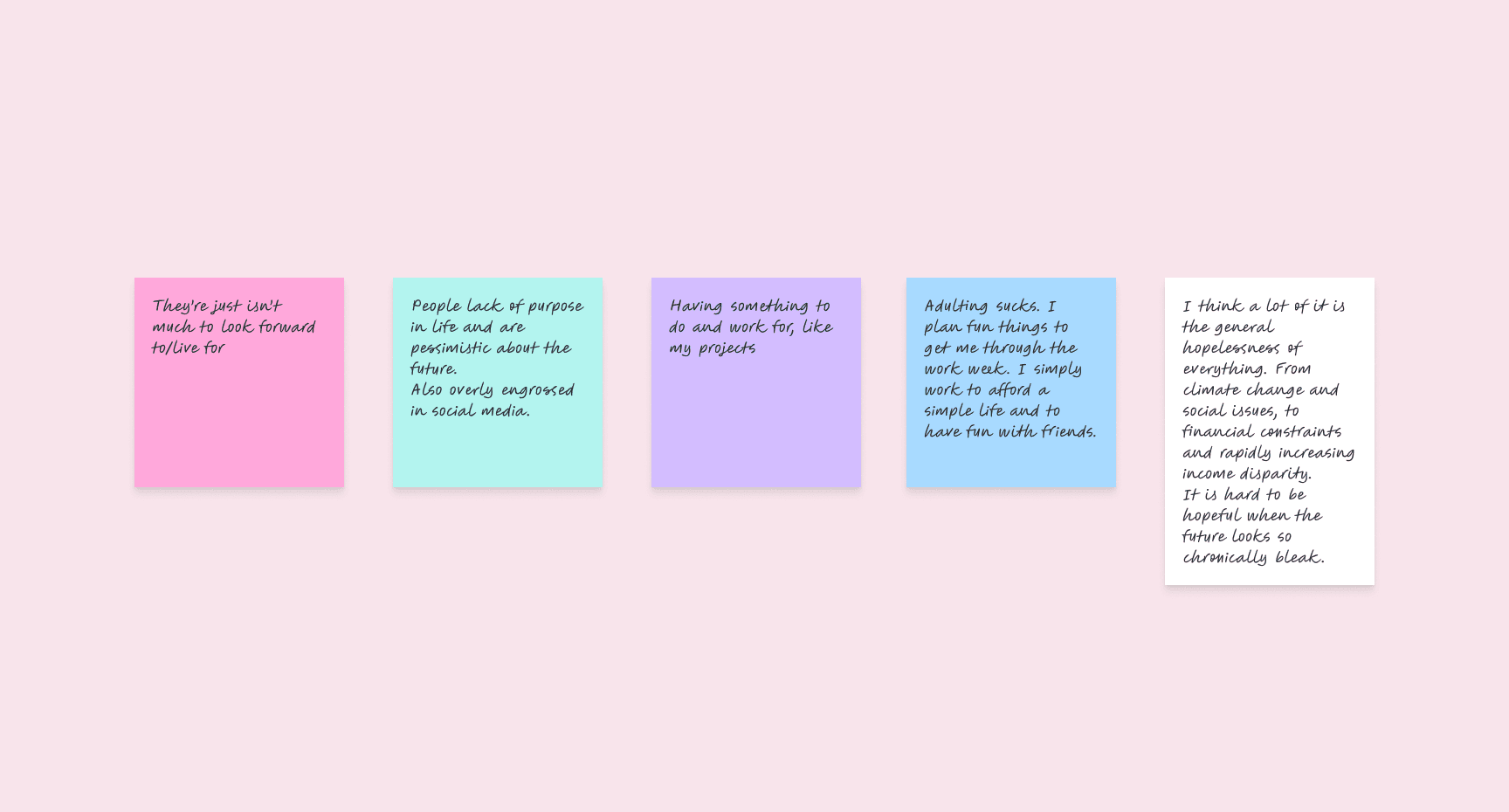
Students described feeling “emotionally flatlined”—not just stressed or anxious, but completely unmotivated. Traditional wellness methods felt exhausting or irrelevant. Gaming and digital creativity, however, still held their attention.
How can we design a healing tool that meets users where they are—apathetic, disconnected, and seeking meaning?
Primary User Research + Forums
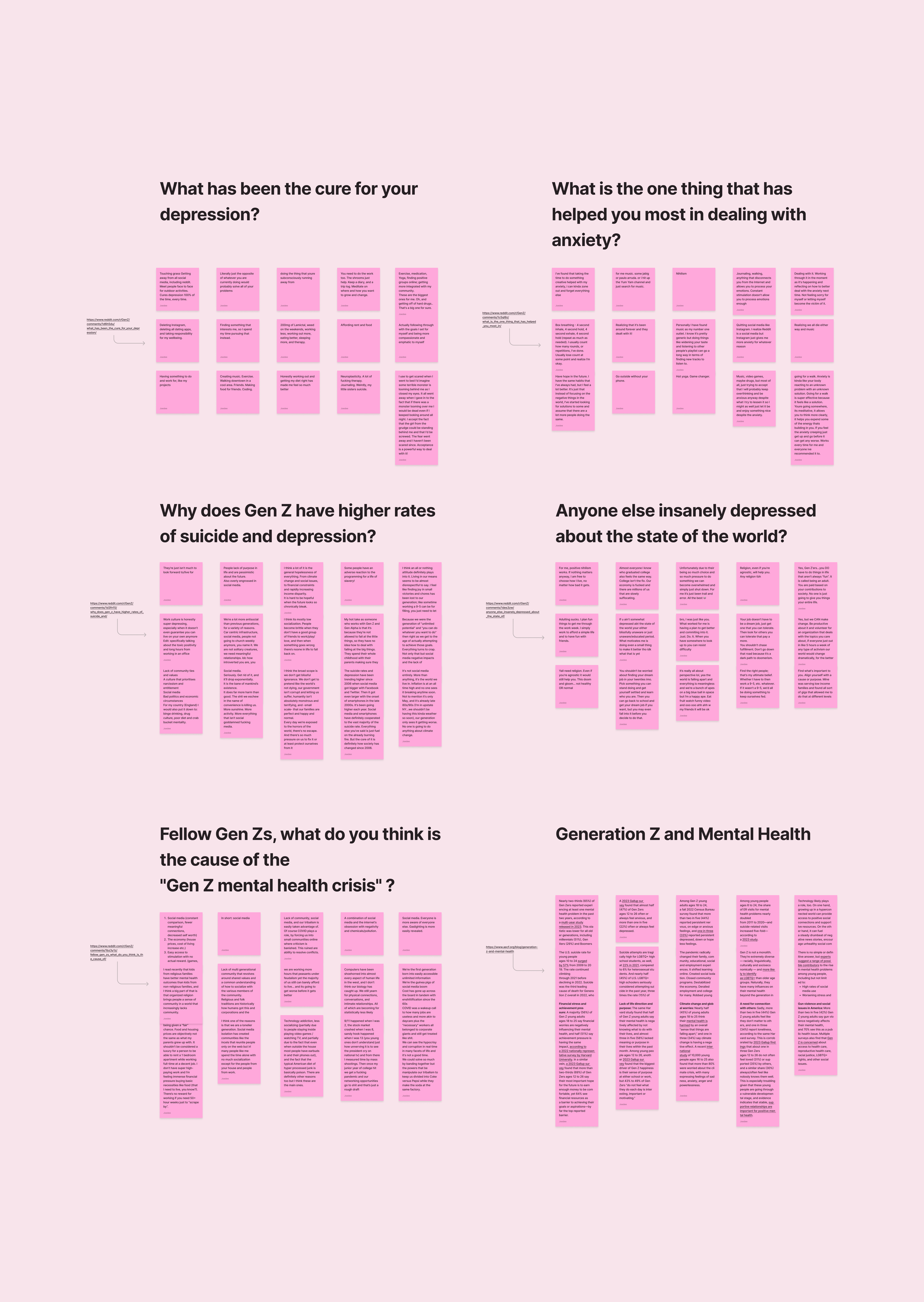
Sourced feedback from Reddit threads on mental health tools, therapy fatigue, and gamified healing.
Revealed how Gen Z simultaneously craves help but resents traditional systems that deliver it.
Persona Generation
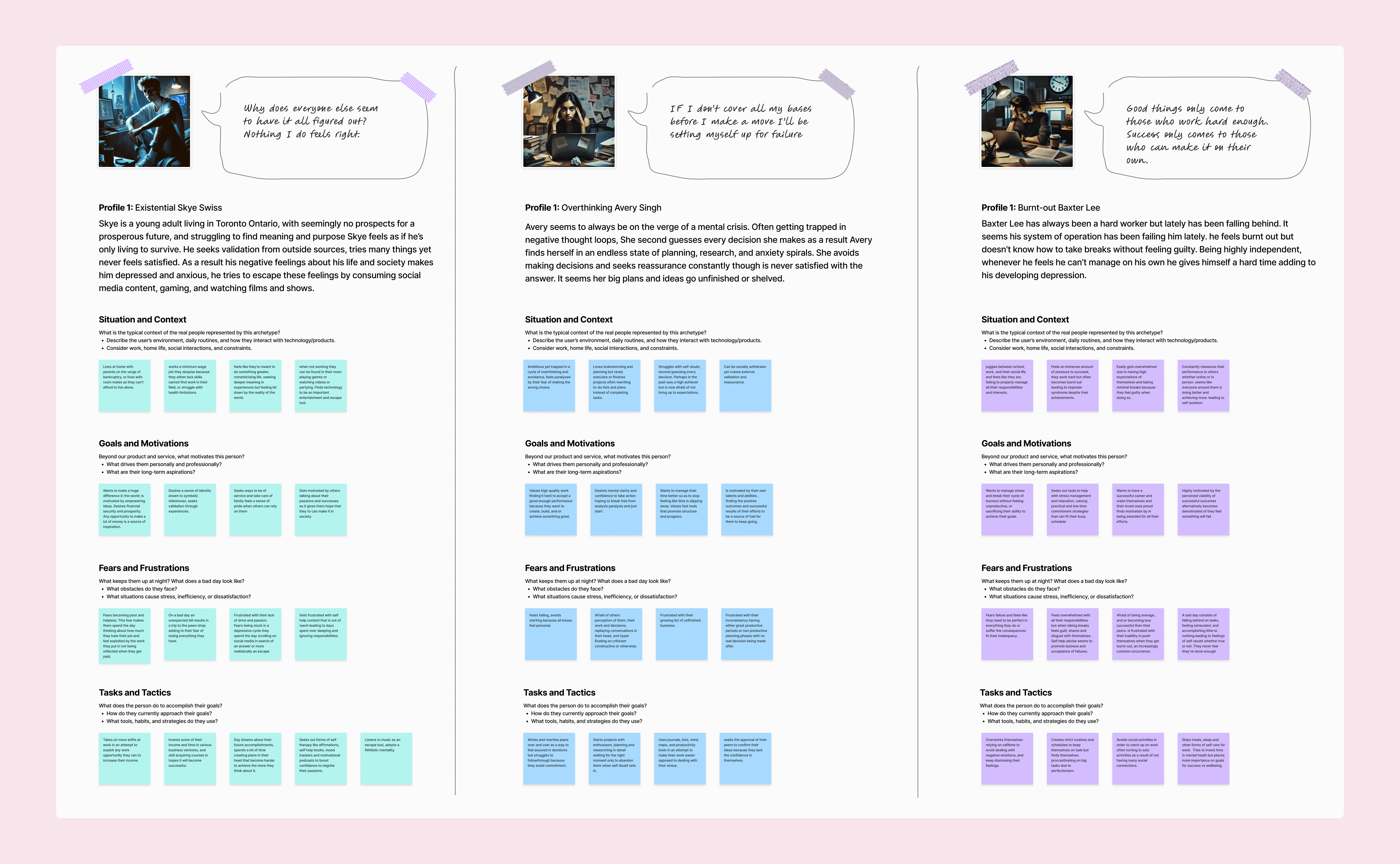
Created 3 original personas and 3 ChatGPT-generated ones to explore emotional goals, digital habits, and creative triggers.
The fictional personas acted as springboards for more human-centered concepts and tone design.
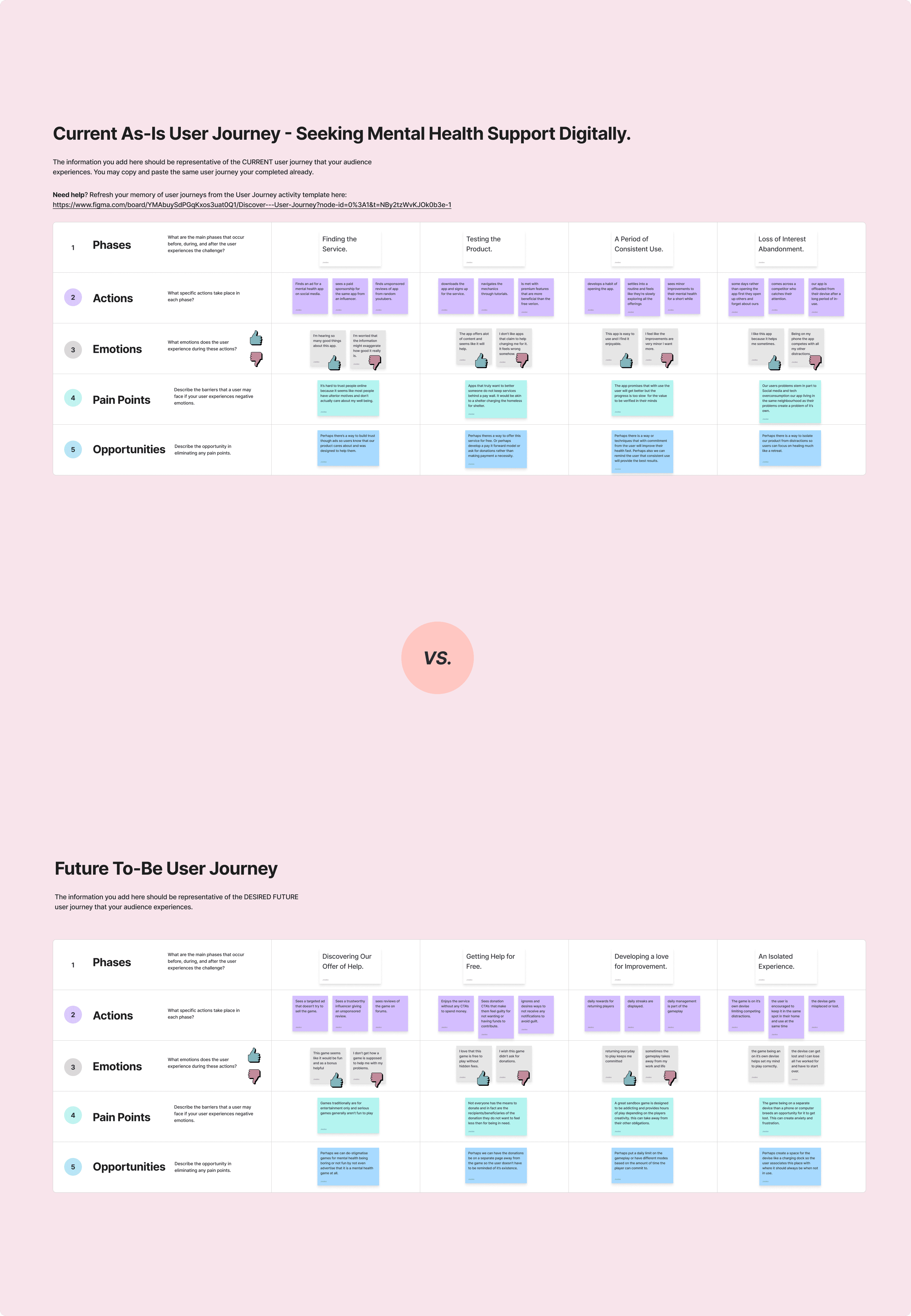
Emotional Journey Mapping
Mapped a typical Gen Z user’s day from wake-up apathy to nightly doomscrolling. Emotional highs were rare. Key moments involved micro-joys: colour, sound, creativity.
Led directly to the visual-mosaic gameplay concept.
Listening to Emotional Fatigue
What does healing need to feel like for Gen Z to actually engage with it?
Apathy is the Default Setting
Students described feeling “emotionally flatlined”—not just stressed or anxious, but completely unmotivated. Traditional wellness methods felt exhausting or irrelevant. Gaming and digital creativity, however, still held their attention.
How can we design a healing tool that meets users where they are—apathetic, disconnected, and seeking meaning?
Primary User Research + Forums
Sourced feedback from Reddit threads on mental health tools, therapy fatigue, and gamified healing.
Revealed how Gen Z simultaneously craves help but resents traditional systems that deliver it.
Persona Generation
Created 3 original personas and 3 ChatGPT-generated ones to explore emotional goals, digital habits, and creative triggers.
The fictional personas acted as springboards for more human-centered concepts and tone design.
Emotional Journey Mapping
Mapped a typical Gen Z user’s day from wake-up apathy to nightly doomscrolling. Emotional highs were rare. Key moments involved micro-joys: colour, sound, creativity.
Led directly to the visual-mosaic gameplay concept.
Listening to Emotional Fatigue
What does healing need to feel like for Gen Z to actually engage with it?
Apathy is the Default Setting
Students described feeling “emotionally flatlined”—not just stressed or anxious, but completely unmotivated. Traditional wellness methods felt exhausting or irrelevant. Gaming and digital creativity, however, still held their attention.
How can we design a healing tool that meets users where they are—apathetic, disconnected, and seeking meaning?
Primary User Research + Forums
Sourced feedback from Reddit threads on mental health tools, therapy fatigue, and gamified healing.
Revealed how Gen Z simultaneously craves help but resents traditional systems that deliver it.
Persona Generation
Created 3 original personas and 3 ChatGPT-generated ones to explore emotional goals, digital habits, and creative triggers.
The fictional personas acted as springboards for more human-centered concepts and tone design.
Emotional Journey Mapping
Mapped a typical Gen Z user’s day from wake-up apathy to nightly doomscrolling. Emotional highs were rare. Key moments involved micro-joys: colour, sound, creativity.
Led directly to the visual-mosaic gameplay concept.
01.Research Phase Title
Research Question goes here what are you trying to uncover?
Main discovery title
This is a description of the discovery. It explains the key finding and what lead to the discovery. This should only be a few lines don’t make it too heavy and full of text you just want to matter of factly explain what it is. It is nice to describe statistics here and pair with an infographic of the stat.
Now that we’ve discovered this main thing we now have a new question that seeks to understand how users feel about this discovery.
Empathizing: Activity 1
This is a description of the first activity that was done to discover the user needs. Talk about what you did.
This is where you reflect on what you discovered and describe something interesting that you figured out during the process.
Empathizing: Activity 2
This is a description of the first activity that was done to discover the user needs. Talk about what you did.
This is where you reflect on what you discovered and describe something interesting that you figured out during the process.
Empathizing: Activity 3
This is a description of the first activity that was done to discover the user needs. Talk about what you did.
This is where you reflect on what you discovered and describe something interesting that you figured out during the process.
Listening to Emotional Fatigue
What does healing need to feel like for Gen Z to actually engage with it?
Apathy is the Default Setting
Students described feeling “emotionally flatlined”—not just stressed or anxious, but completely unmotivated. Traditional wellness methods felt exhausting or irrelevant. Gaming and digital creativity, however, still held their attention.
How can we design a healing tool that meets users where they are—apathetic, disconnected, and seeking meaning?
Primary User Research + Forums
Sourced feedback from Reddit threads on mental health tools, therapy fatigue, and gamified healing.
Revealed how Gen Z simultaneously craves help but resents traditional systems that deliver it.
Persona Generation
Created 3 original personas and 3 ChatGPT-generated ones to explore emotional goals, digital habits, and creative triggers.
The fictional personas acted as springboards for more human-centered concepts and tone design.
Emotional Journey Mapping
Mapped a typical Gen Z user’s day from wake-up apathy to nightly doomscrolling. Emotional highs were rare. Key moments involved micro-joys: colour, sound, creativity.
Led directly to the visual-mosaic gameplay concept.
01.Research Phase Title
Research Question goes here what are you trying to uncover?
Main discovery title
This is a description of the discovery. It explains the key finding and what lead to the discovery. This should only be a few lines don’t make it too heavy and full of text you just want to matter of factly explain what it is. It is nice to describe statistics here and pair with an infographic of the stat.
Now that we’ve discovered this main thing we now have a new question that seeks to understand how users feel about this discovery.
Empathizing: Activity 1
This is a description of the first activity that was done to discover the user needs. Talk about what you did.
This is where you reflect on what you discovered and describe something interesting that you figured out during the process.
Empathizing: Activity 2
This is a description of the first activity that was done to discover the user needs. Talk about what you did.
This is where you reflect on what you discovered and describe something interesting that you figured out during the process.
Empathizing: Activity 3
This is a description of the first activity that was done to discover the user needs. Talk about what you did.
This is where you reflect on what you discovered and describe something interesting that you figured out during the process.
Listening to Emotional Fatigue
What does healing need to feel like for Gen Z to actually engage with it?
Apathy is the Default Setting
Students described feeling “emotionally flatlined”—not just stressed or anxious, but completely unmotivated. Traditional wellness methods felt exhausting or irrelevant. Gaming and digital creativity, however, still held their attention.
How can we design a healing tool that meets users where they are—apathetic, disconnected, and seeking meaning?
Primary User Research + Forums
Sourced feedback from Reddit threads on mental health tools, therapy fatigue, and gamified healing.
Revealed how Gen Z simultaneously craves help but resents traditional systems that deliver it.
Persona Generation
Created 3 original personas and 3 ChatGPT-generated ones to explore emotional goals, digital habits, and creative triggers.
The fictional personas acted as springboards for more human-centered concepts and tone design.
Emotional Journey Mapping
Mapped a typical Gen Z user’s day from wake-up apathy to nightly doomscrolling. Emotional highs were rare. Key moments involved micro-joys: colour, sound, creativity.
Led directly to the visual-mosaic gameplay concept.
01.Research Phase Title
Research Question goes here what are you trying to uncover?
Main discovery title
This is a description of the discovery. It explains the key finding and what lead to the discovery. This should only be a few lines don’t make it too heavy and full of text you just want to matter of factly explain what it is. It is nice to describe statistics here and pair with an infographic of the stat.
Now that we’ve discovered this main thing we now have a new question that seeks to understand how users feel about this discovery.
Empathizing: Activity 1
This is a description of the first activity that was done to discover the user needs. Talk about what you did.
This is where you reflect on what you discovered and describe something interesting that you figured out during the process.
Empathizing: Activity 2
This is a description of the first activity that was done to discover the user needs. Talk about what you did.
This is where you reflect on what you discovered and describe something interesting that you figured out during the process.
Empathizing: Activity 3
This is a description of the first activity that was done to discover the user needs. Talk about what you did.
This is where you reflect on what you discovered and describe something interesting that you figured out during the process.
Listening to Emotional Fatigue
What does healing need to feel like for Gen Z to actually engage with it?
Apathy is the Default Setting
Students described feeling “emotionally flatlined”—not just stressed or anxious, but completely unmotivated. Traditional wellness methods felt exhausting or irrelevant. Gaming and digital creativity, however, still held their attention.
How can we design a healing tool that meets users where they are—apathetic, disconnected, and seeking meaning?
Primary User Research + Forums
Sourced feedback from Reddit threads on mental health tools, therapy fatigue, and gamified healing.
Revealed how Gen Z simultaneously craves help but resents traditional systems that deliver it.
Persona Generation
Created 3 original personas and 3 ChatGPT-generated ones to explore emotional goals, digital habits, and creative triggers.
HMWs gave shape to previously abstract concepts.
Emotional Journey Mapping
Final direction was guided by three principles: Emotional Safety, Agency in Healing, and Sensory Joy.
This helped prioritize calm UI and voice-led reflection moments.
01.Research Phase Title
Research Question goes here what are you trying to uncover?
Main discovery title
This is a description of the discovery. It explains the key finding and what lead to the discovery. This should only be a few lines don’t make it too heavy and full of text you just want to matter of factly explain what it is. It is nice to describe statistics here and pair with an infographic of the stat.
Now that we’ve discovered this main thing we now have a new question that seeks to understand how users feel about this discovery.
Empathizing: Activity 1
This is a description of the first activity that was done to discover the user needs. Talk about what you did.
This is where you reflect on what you discovered and describe something interesting that you figured out during the process.
Empathizing: Activity 2
This is a description of the first activity that was done to discover the user needs. Talk about what you did.
This is where you reflect on what you discovered and describe something interesting that you figured out during the process.
Empathizing: Activity 3
This is a description of the first activity that was done to discover the user needs. Talk about what you did.
This is where you reflect on what you discovered and describe something interesting that you figured out during the process.
Listening to Emotional Fatigue
What does healing need to feel like for Gen Z to actually engage with it?
Apathy is the Default Setting
Students described feeling “emotionally flatlined”—not just stressed or anxious, but completely unmotivated. Traditional wellness methods felt exhausting or irrelevant. Gaming and digital creativity, however, still held their attention.
How can we design a healing tool that meets users where they are—apathetic, disconnected, and seeking meaning?
Primary User Research + Forums
Sourced feedback from Reddit threads on mental health tools, therapy fatigue, and gamified healing.
Revealed how Gen Z simultaneously craves help but resents traditional systems that deliver it.
Persona Generation
Created 3 original personas and 3 ChatGPT-generated ones to explore emotional goals, digital habits, and creative triggers.
The fictional personas acted as springboards for more human-centered concepts and tone design.
Emotional Journey Mapping
Mapped a typical Gen Z user’s day from wake-up apathy to nightly doomscrolling. Emotional highs were rare. Key moments involved micro-joys: colour, sound, creativity.
Led directly to the visual-mosaic gameplay concept.
01.Research Phase Title
Research Question goes here what are you trying to uncover?
Main discovery title
This is a description of the discovery. It explains the key finding and what lead to the discovery. This should only be a few lines don’t make it too heavy and full of text you just want to matter of factly explain what it is. It is nice to describe statistics here and pair with an infographic of the stat.
Now that we’ve discovered this main thing we now have a new question that seeks to understand how users feel about this discovery.
Empathizing: Activity 1
This is a description of the first activity that was done to discover the user needs. Talk about what you did.
This is where you reflect on what you discovered and describe something interesting that you figured out during the process.
Empathizing: Activity 2
This is a description of the first activity that was done to discover the user needs. Talk about what you did.
This is where you reflect on what you discovered and describe something interesting that you figured out during the process.
Empathizing: Activity 3
This is a description of the first activity that was done to discover the user needs. Talk about what you did.
This is where you reflect on what you discovered and describe something interesting that you figured out during the process.
Listening to Emotional Fatigue
What does healing need to feel like for Gen Z to actually engage with it?
Apathy is the Default Setting
Students described feeling “emotionally flatlined”—not just stressed or anxious, but completely unmotivated. Traditional wellness methods felt exhausting or irrelevant. Gaming and digital creativity, however, still held their attention.
How can we design a healing tool that meets users where they are—apathetic, disconnected, and seeking meaning?
Primary User Research + Forums
Sourced feedback from Reddit threads on mental health tools, therapy fatigue, and gamified healing.
Revealed how Gen Z simultaneously craves help but resents traditional systems that deliver it.
Persona Generation
Created 3 original personas and 3 ChatGPT-generated ones to explore emotional goals, digital habits, and creative triggers.
The fictional personas acted as springboards for more human-centered concepts and tone design.
Emotional Journey Mapping
Final direction was guided by three principles: Emotional Safety, Agency in Healing, and Sensory Joy.
This helped prioritize calm UI and voice-led reflection moments.
01.Research Phase Title
Research Question goes here what are you trying to uncover?
Main discovery title
This is a description of the discovery. It explains the key finding and what lead to the discovery. This should only be a few lines don’t make it too heavy and full of text you just want to matter of factly explain what it is. It is nice to describe statistics here and pair with an infographic of the stat.
Now that we’ve discovered this main thing we now have a new question that seeks to understand how users feel about this discovery.
Empathizing: Activity 1
This is a description of the first activity that was done to discover the user needs. Talk about what you did.
This is where you reflect on what you discovered and describe something interesting that you figured out during the process.
Empathizing: Activity 2
This is a description of the first activity that was done to discover the user needs. Talk about what you did.
This is where you reflect on what you discovered and describe something interesting that you figured out during the process.
Empathizing: Activity 3
This is a description of the first activity that was done to discover the user needs. Talk about what you did.
This is where you reflect on what you discovered and describe something interesting that you figured out during the process.
Listening to Emotional Fatigue
What does healing need to feel like for Gen Z to actually engage with it?
Apathy is the Default Setting
Students described feeling “emotionally flatlined”—not just stressed or anxious, but completely unmotivated. Traditional wellness methods felt exhausting or irrelevant. Gaming and digital creativity, however, still held their attention.
How can we design a healing tool that meets users where they are—apathetic, disconnected, and seeking meaning?
Primary User Research + Forums
Sourced feedback from Reddit threads on mental health tools, therapy fatigue, and gamified healing.
Revealed how Gen Z simultaneously craves help but resents traditional systems that deliver it.
Persona Generation
Created 3 original personas and 3 ChatGPT-generated ones to explore emotional goals, digital habits, and creative triggers.
The fictional personas acted as springboards for more human-centered concepts and tone design.
Emotional Journey Mapping
Mapped a typical Gen Z user’s day from wake-up apathy to nightly doomscrolling. Emotional highs were rare. Key moments involved micro-joys: colour, sound, creativity.
Led directly to the visual-mosaic gameplay concept.
02.Define Phase Title
Define phase subheading to encapsulate the meaning of the phase.
Defining : Activity 1
This is a description of the first activity that was done to define the user problems. Talk about what you did.
This is where you reflect on what you discovered and describe something interesting that you figured out during the process.
Defining : Activity 2
This is a description of the first activity that was done to define the user problems. Talk about what you did.
This is where you reflect on what you discovered and describe something interesting that you figured out during the process.
Defining : Activity 1
This is a description of the first activity that was done to define the user problems. Talk about what you did.
This is where you reflect on what you discovered and describe something interesting that you figured out during the process.
KEY INSIGHTS
How might we statement goes here.
Diagnosing the Disconnect
Reframing therapy as play

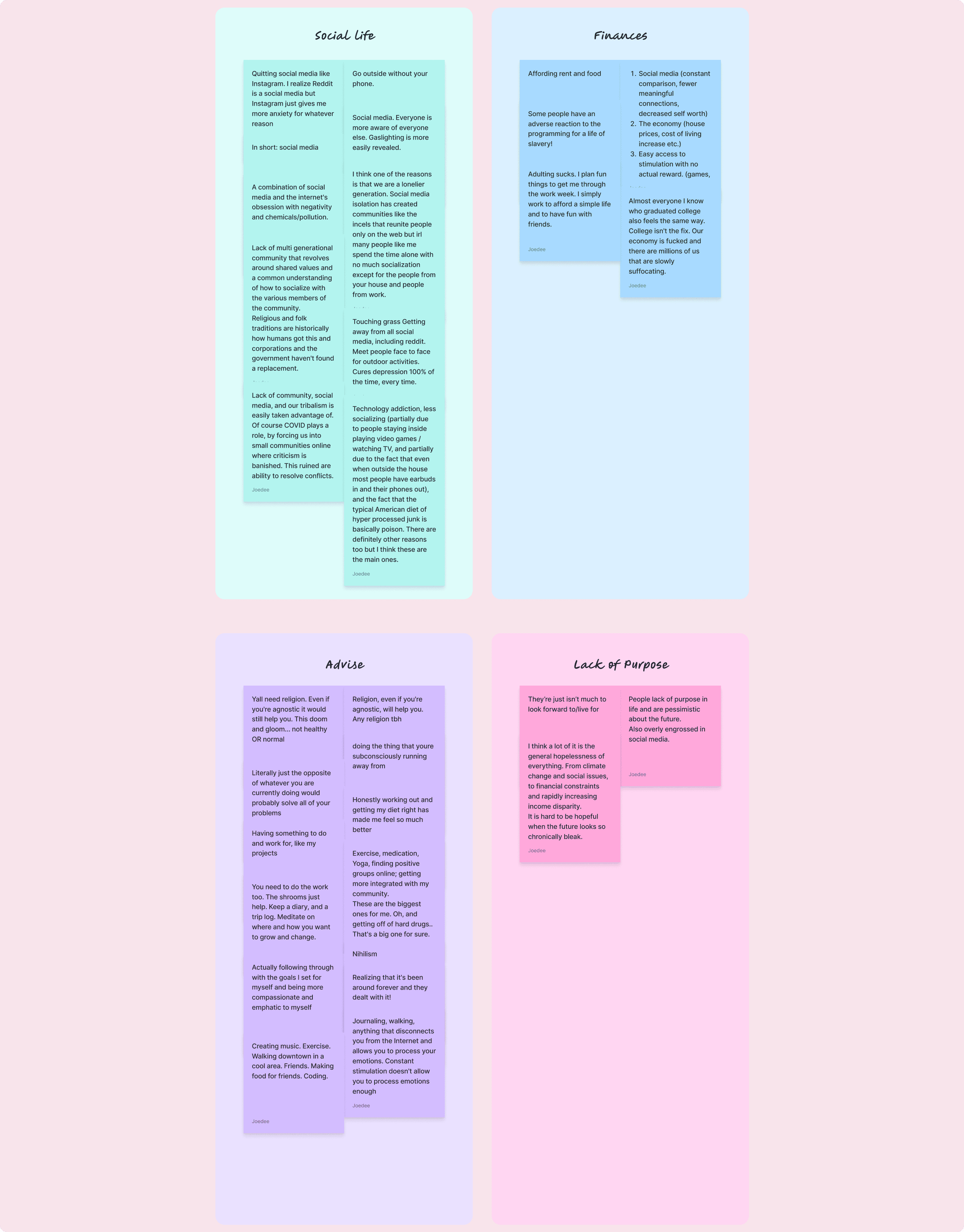
Affinity Mapping
Clustered pain points into themes: emotional exhaustion, resistance to structure, love of customisation, visual self-expression.
These categories informed the need for a slow, open-ended, mood-safe space.
How Might We Statements
Asked: “How might we make healing feel like exploration?” “How might we introduce CBT gently, without labels?”
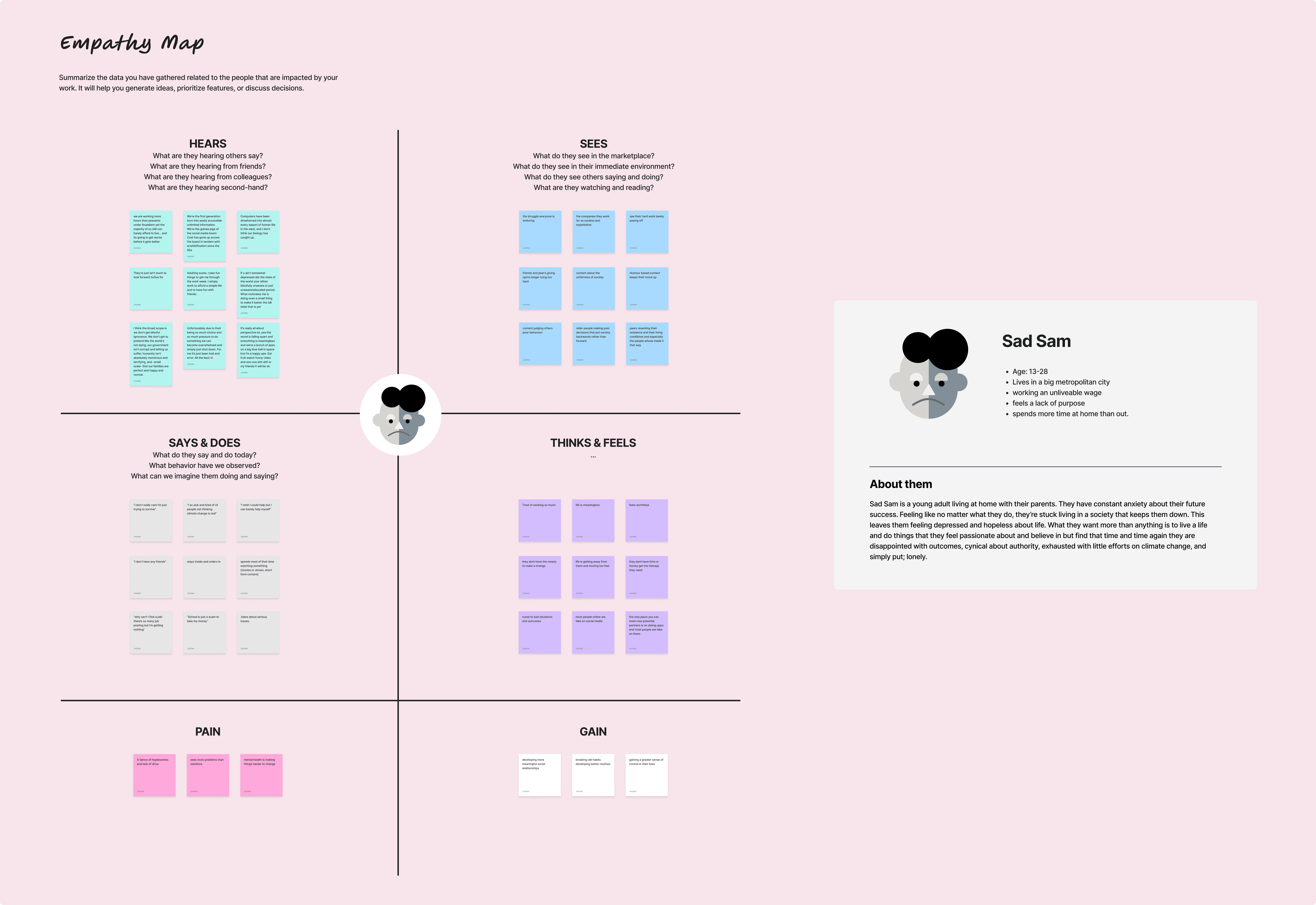
HMWs gave shape to previously abstract concepts.
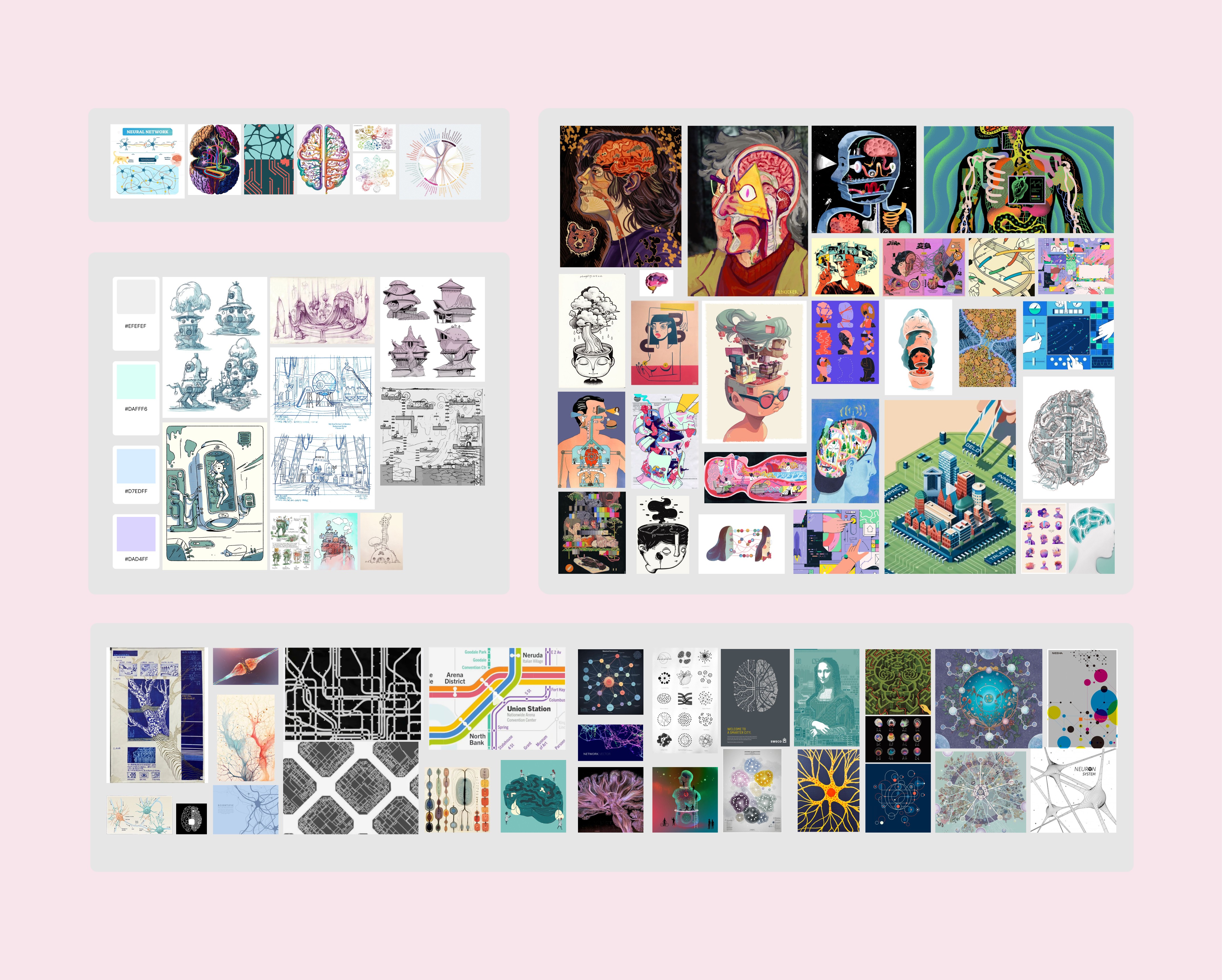
Design Pillars + Ideation
Final direction was guided by three principles: Emotional Safety, Agency in Healing, and Sensory Joy.
This helped prioritize calm UI and voice-led reflection moments.
Make Therapy Optional, Not Obvious
How might we help players reflect without ever saying the word “therapy”?
02.Define Phase Title
Define phase subheading to encapsulate the meaning of the phase.
Defining : Activity 1
This is a description of the first activity that was done to define the user problems. Talk about what you did.
This is where you reflect on what you discovered and describe something interesting that you figured out during the process.
Defining : Activity 2
This is a description of the first activity that was done to define the user problems. Talk about what you did.
This is where you reflect on what you discovered and describe something interesting that you figured out during the process.
Defining : Activity 1
This is a description of the first activity that was done to define the user problems. Talk about what you did.
This is where you reflect on what you discovered and describe something interesting that you figured out during the process.
KEY INSIGHTS
How might we statement goes here.
Diagnosing the Disconnect
Reframing therapy as play
Affinity Mapping
Clustered pain points into themes: emotional exhaustion, resistance to structure, love of customisation, visual self-expression.
These categories informed the need for a slow, open-ended, mood-safe space.
How Might We Statements
Asked: “How might we make healing feel like exploration?” “How might we introduce CBT gently, without labels?”
HMWs gave shape to previously abstract concepts.
Design Pillars + Ideation
Final direction was guided by three principles: Emotional Safety, Agency in Healing, and Sensory Joy.
This helped prioritize calm UI and voice-led reflection moments.
Make Therapy Optional, Not Obvious
How might we help players reflect without ever saying the word “therapy”?
02.Define Phase Title
Define phase subheading to encapsulate the meaning of the phase.
Defining : Activity 1
This is a description of the first activity that was done to define the user problems. Talk about what you did.
This is where you reflect on what you discovered and describe something interesting that you figured out during the process.
Defining : Activity 2
This is a description of the first activity that was done to define the user problems. Talk about what you did.
This is where you reflect on what you discovered and describe something interesting that you figured out during the process.
Defining : Activity 1
This is a description of the first activity that was done to define the user problems. Talk about what you did.
This is where you reflect on what you discovered and describe something interesting that you figured out during the process.
KEY INSIGHTS
How might we statement goes here.
Diagnosing the Disconnect
Reframing therapy as play
Affinity Mapping
Clustered pain points into themes: emotional exhaustion, resistance to structure, love of customisation, visual self-expression.
These categories informed the need for a slow, open-ended, mood-safe space.
How Might We Statements
Asked: “How might we make healing feel like exploration?” “How might we introduce CBT gently, without labels?”
HMWs gave shape to previously abstract concepts.
Design Pillars + Ideation
Final direction was guided by three principles: Emotional Safety, Agency in Healing, and Sensory Joy.
This helped prioritize calm UI and voice-led reflection moments.
Make Therapy Optional, Not Obvious
How might we help players reflect without ever saying the word “therapy”?
02.Define Phase Title
Define phase subheading to encapsulate the meaning of the phase.
Defining : Activity 1
This is a description of the first activity that was done to define the user problems. Talk about what you did.
This is where you reflect on what you discovered and describe something interesting that you figured out during the process.
Defining : Activity 2
This is a description of the first activity that was done to define the user problems. Talk about what you did.
This is where you reflect on what you discovered and describe something interesting that you figured out during the process.
Defining : Activity 1
This is a description of the first activity that was done to define the user problems. Talk about what you did.
This is where you reflect on what you discovered and describe something interesting that you figured out during the process.
KEY INSIGHTS
How might we statement goes here.
Diagnosing the Disconnect
Reframing therapy as play
Affinity Mapping
Clustered pain points into themes: emotional exhaustion, resistance to structure, love of customisation, visual self-expression.
These categories informed the need for a slow, open-ended, mood-safe space.
How Might We Statements
Asked: “How might we make healing feel like exploration?” “How might we introduce CBT gently, without labels?”
HMWs gave shape to previously abstract concepts.
Design Pillars + Ideation
Final direction was guided by three principles: Emotional Safety, Agency in Healing, and Sensory Joy.
This helped prioritize calm UI and voice-led reflection moments.
Make Therapy Optional, Not Obvious
How might we help players reflect without ever saying the word “therapy”?
02.Define Phase Title
Define phase subheading to encapsulate the meaning of the phase.
Defining : Activity 1
This is a description of the first activity that was done to define the user problems. Talk about what you did.
This is where you reflect on what you discovered and describe something interesting that you figured out during the process.
Defining : Activity 2
This is a description of the first activity that was done to define the user problems. Talk about what you did.
This is where you reflect on what you discovered and describe something interesting that you figured out during the process.
Defining : Activity 1
This is a description of the first activity that was done to define the user problems. Talk about what you did.
This is where you reflect on what you discovered and describe something interesting that you figured out during the process.
KEY INSIGHTS
How might we statement goes here.
Diagnosing the Disconnect
Reframing therapy as play
Affinity Mapping
Clustered pain points into themes: emotional exhaustion, resistance to structure, love of customisation, visual self-expression.
These categories informed the need for a slow, open-ended, mood-safe space.
How Might We Statements
Asked: “How might we make healing feel like exploration?” “How might we introduce CBT gently, without labels?”
HMWs gave shape to previously abstract concepts.
Design Pillars + Ideation
Final direction was guided by three principles: Emotional Safety, Agency in Healing, and Sensory Joy.
This helped prioritize calm UI and voice-led reflection moments.
Make Therapy Optional, Not Obvious
How might we help players reflect without ever saying the word “therapy”?
02.Define Phase Title
Define phase subheading to encapsulate the meaning of the phase.
Defining : Activity 1
This is a description of the first activity that was done to define the user problems. Talk about what you did.
This is where you reflect on what you discovered and describe something interesting that you figured out during the process.
Defining : Activity 2
This is a description of the first activity that was done to define the user problems. Talk about what you did.
This is where you reflect on what you discovered and describe something interesting that you figured out during the process.
Defining : Activity 1
This is a description of the first activity that was done to define the user problems. Talk about what you did.
This is where you reflect on what you discovered and describe something interesting that you figured out during the process.
KEY INSIGHTS
How might we statement goes here.
Diagnosing the Disconnect
Reframing therapy as play
Affinity Mapping
Clustered pain points into themes: emotional exhaustion, resistance to structure, love of customisation, visual self-expression.
These categories informed the need for a slow, open-ended, mood-safe space.
How Might We Statements
Asked: “How might we make healing feel like exploration?” “How might we introduce CBT gently, without labels?”
HMWs gave shape to previously abstract concepts.
Design Pillars + Ideation
Final direction was guided by three principles: Emotional Safety, Agency in Healing, and Sensory Joy.
This helped prioritize calm UI and voice-led reflection moments.
Make Therapy Optional, Not Obvious
How might we help players reflect without ever saying the word “therapy”?
Diagnosing the Disconnect
Reframing therapy as play
Affinity Mapping
Clustered pain points into themes: emotional exhaustion, resistance to structure, love of customisation, visual self-expression.
Revealed how Gen Z simultaneously craves help but resents traditional systems that deliver it.
How Might We Statements
Asked: “How might we make healing feel like exploration?” “How might we introduce CBT gently, without labels?”
HMWs gave shape to previously abstract concepts.
Design Pillars + Ideation
Final direction was guided by three principles: Emotional Safety, Agency in Healing, and Sensory Joy.
This helped prioritize calm UI and voice-led reflection moments.
Make Therapy Optional, Not Obvious
How might we help players reflect without ever saying the word “therapy”?
Diagnosing the Disconnect
Reframing therapy as play
Affinity Mapping
Clustered pain points into themes: emotional exhaustion, resistance to structure, love of customisation, visual self-expression.
These categories informed the need for a slow, open-ended, mood-safe space.
How Might We Statements
Asked: “How might we make healing feel like exploration?” “How might we introduce CBT gently, without labels?”
HMWs gave shape to previously abstract concepts.
Design Pillars + Ideation
Final direction was guided by three principles: Emotional Safety, Agency in Healing, and Sensory Joy.
This helped prioritize calm UI and voice-led reflection moments.
Make Therapy Optional, Not Obvious
How might we help players reflect without ever saying the word “therapy”?
Diagnosing the Disconnect
Reframing therapy as play
Affinity Mapping
Sourced feedback from Reddit threads on mental health tools, therapy fatigue, and gamified healing.
These categories informed the need for a slow, open-ended, mood-safe space.
How Might We Statements
Asked: “How might we make healing feel like exploration?” “How might we introduce CBT gently, without labels?”
HMWs gave shape to previously abstract concepts.
Design Pillars + Ideation
Final direction was guided by three principles: Emotional Safety, Agency in Healing, and Sensory Joy.
This helped prioritize calm UI and voice-led reflection moments.
Make Therapy Optional, Not Obvious
How might we help players reflect without ever saying the word “therapy”?
Diagnosing the Disconnect
Reframing therapy as play
Affinity Mapping
Clustered pain points into themes: emotional exhaustion, resistance to structure, love of customisation, visual self-expression.
These categories informed the need for a slow, open-ended, mood-safe space.
How Might We Statements
Asked: “How might we make healing feel like exploration?” “How might we introduce CBT gently, without labels?”
Asked: “How might we make healing feel like exploration?” “How might we introduce CBT gently, without labels?”
Design Pillars + Ideation
Final direction was guided by three principles: Emotional Safety, Agency in Healing, and Sensory Joy.
This helped prioritize calm UI and voice-led reflection moments.
Make Therapy Optional, Not Obvious
How might we help players reflect without ever saying the word “therapy”?
Diagnosing the Disconnect
Reframing therapy as play
Affinity Mapping
Clustered pain points into themes: emotional exhaustion, resistance to structure, love of customisation, visual self-expression.
These categories informed the need for a slow, open-ended, mood-safe space.
How Might We Statements
Asked: “How might we make healing feel like exploration?” “How might we introduce CBT gently, without labels?”
HMWs gave shape to previously abstract concepts.
Design Pillars + Ideation
Final direction was guided by three principles: Emotional Safety, Agency in Healing, and Sensory Joy.
This helped prioritize calm UI and voice-led reflection moments.
Make Therapy Optional, Not Obvious
How might we help players reflect without ever saying the word “therapy”?
Prototyping Mind-Space
Building healing into interaction

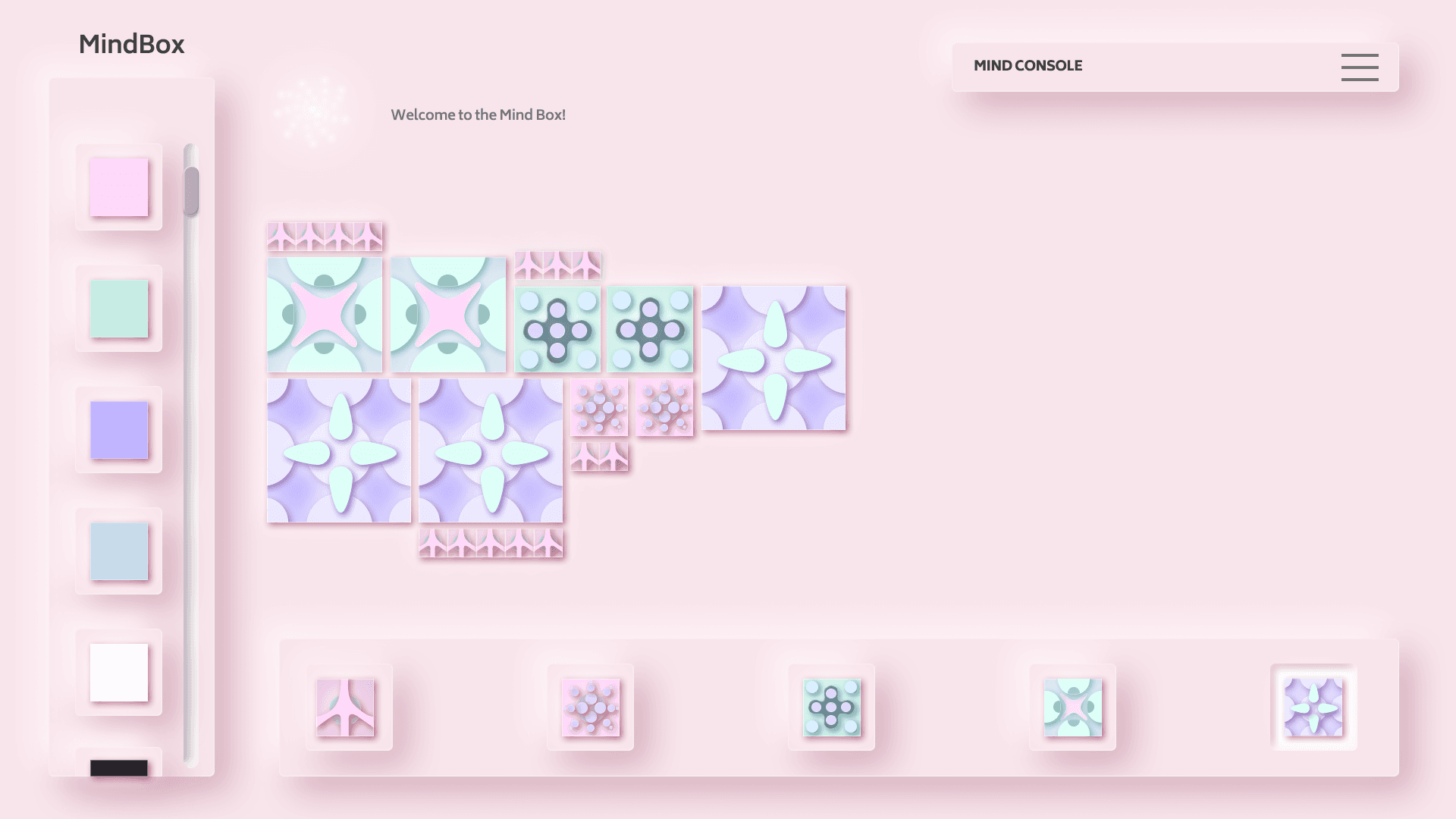
Mosaic Tile System
Created a tile system using various shapes, patterns, and colour palettes. Each tile represents a thought, emotion, or behaviour.
Making abstract mental health concepts tangible helped ease players into reflection without pressure.
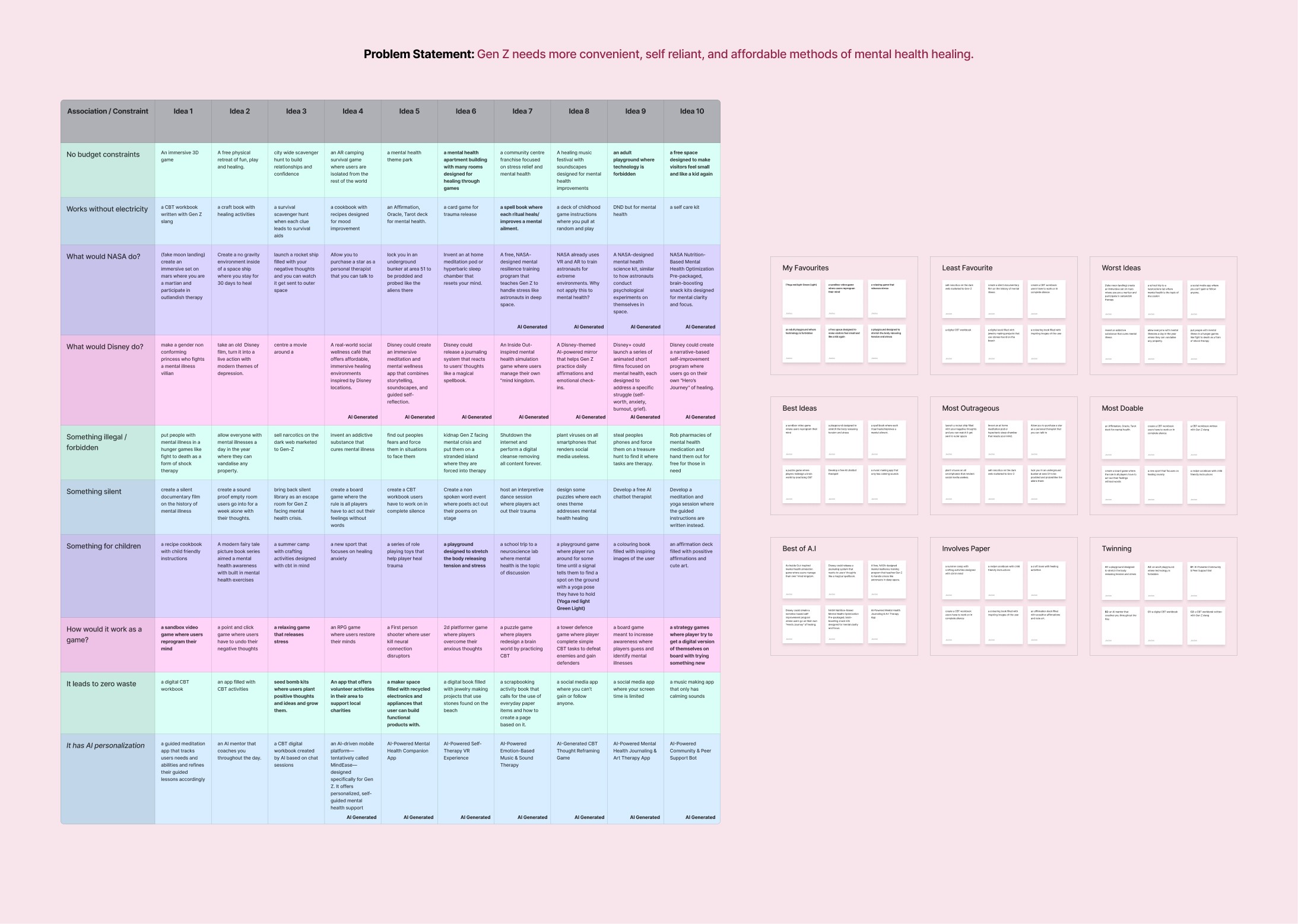
100 Ideas in 30 Minutes
I used the 100 ideas in 30 minutes method to rapidly generate a wide range of concepts; from game mechanics and visual metaphors to emotional triggers and UI possibilities.
This method removed self-censorship and helped surface imaginative and unexpected directions that aligned with Gen Z’s need for open-ended interaction.
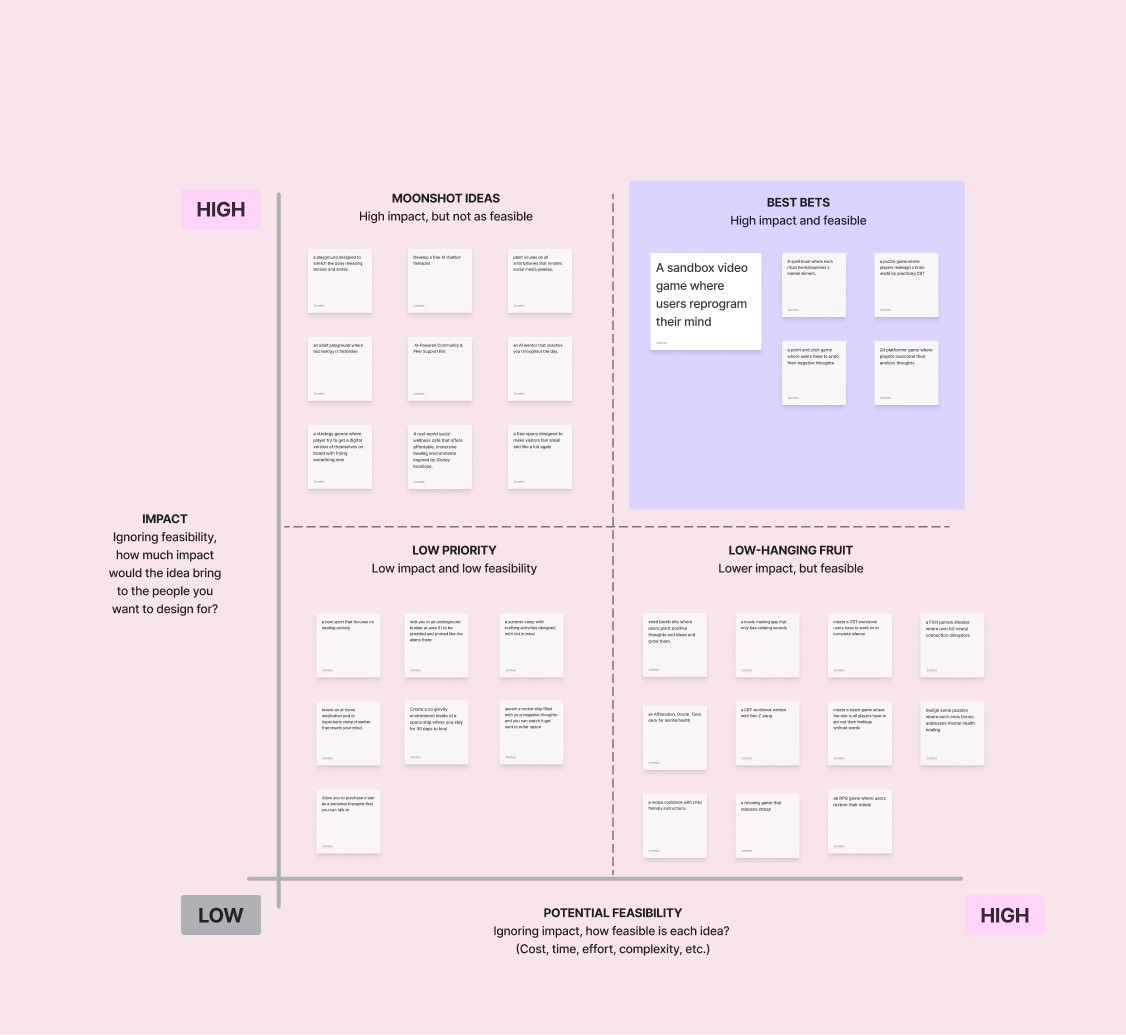
Decision Matrix
After ideation, I used a decision matrix to score the top ideas based on feasibility and emotional impact. This helped filter high-potential concepts and guided which features to prototype first.
he matrix ensured that concept selection wasn’t just creative; it was strategic.
Prototyping Mind-Space
Building healing into interaction
Mosaic Tile System
Created a tile system using various shapes, patterns, and colour palettes. Each tile represents a thought, emotion, or behaviour.
Making abstract mental health concepts tangible helped ease players into reflection without pressure.
100 Ideas in 30 Minutes
I used the 100 ideas in 30 minutes method to rapidly generate a wide range of concepts; from game mechanics and visual metaphors to emotional triggers and UI possibilities.
This method removed self-censorship and helped surface imaginative and unexpected directions that aligned with Gen Z’s need for open-ended interaction.
Decision Matrix
After ideation, I used a decision matrix to score the top ideas based on feasibility and emotional impact. This helped filter high-potential concepts and guided which features to prototype first.
he matrix ensured that concept selection wasn’t just creative; it was strategic.
Prototyping Mind-Space
Building healing into interaction
Mosaic Tile System
Created a tile system using various shapes, patterns, and colour palettes. Each tile represents a thought, emotion, or behaviour.
Making abstract mental health concepts tangible helped ease players into reflection without pressure.
100 Ideas in 30 Minutes
I used the 100 ideas in 30 minutes method to rapidly generate a wide range of concepts; from game mechanics and visual metaphors to emotional triggers and UI possibilities.
This method removed self-censorship and helped surface imaginative and unexpected directions that aligned with Gen Z’s need for open-ended interaction.
Decision Matrix
After ideation, I used a decision matrix to score the top ideas based on feasibility and emotional impact. This helped filter high-potential concepts and guided which features to prototype first.
he matrix ensured that concept selection wasn’t just creative; it was strategic.
Healing Should Be Playful
What would therapy look like if it felt more like Minecraft?
You Can Heal Creatively
Design for Emotional Apathy
Gen Z isn’t lazy—they’re overloaded. Design must account for emotional flatness.
Reflection is Power
Asking users to pause, think, and respond creates deeper emotional memory.
Beauty Helps People Stay
Soft gradients and fluid animations are more than aesthetic—they’re emotional safety nets.
Where Mindbox Could Grow
Add Dynamic Prompts
Base CBT interactions on previous player responses or mood check-ins.
Expand Visual Toolkit
More shapes, textures, and tile options to increase expressive capacity.
Partner With Therapists
Ensure prompts reflect best CBT practices while maintaining playfulness.
Healing Should Be Playful
What would therapy look like if it felt more like Minecraft?
You Can Heal Creatively
Design for Emotional Apathy
Gen Z isn’t lazy—they’re overloaded. Design must account for emotional flatness.
Reflection is Power
Asking users to pause, think, and respond creates deeper emotional memory.
Beauty Helps People Stay
Soft gradients and fluid animations are more than aesthetic—they’re emotional safety nets.
Where Mindbox Could Grow
Add Dynamic Prompts
Base CBT interactions on previous player responses or mood check-ins.
Expand Visual Toolkit
More shapes, textures, and tile options to increase expressive capacity.
Partner With Therapists
Ensure prompts reflect best CBT practices while maintaining playfulness.
Healing Should Be Playful
What would therapy look like if it felt more like Minecraft?
You Can Heal Creatively
Design for Emotional Apathy
Gen Z isn’t lazy—they’re overloaded. Design must account for emotional flatness.
Reflection is Power
Asking users to pause, think, and respond creates deeper emotional memory.
Beauty Helps People Stay
Soft gradients and fluid animations are more than aesthetic—they’re emotional safety nets.
Where Mindbox Could Grow
Add Dynamic Prompts
Base CBT interactions on previous player responses or mood check-ins.
Expand Visual Toolkit
More shapes, textures, and tile options to increase expressive capacity.
Partner With Therapists
Ensure prompts reflect best CBT practices while maintaining playfulness.
MORE WORK
MORE WORK